
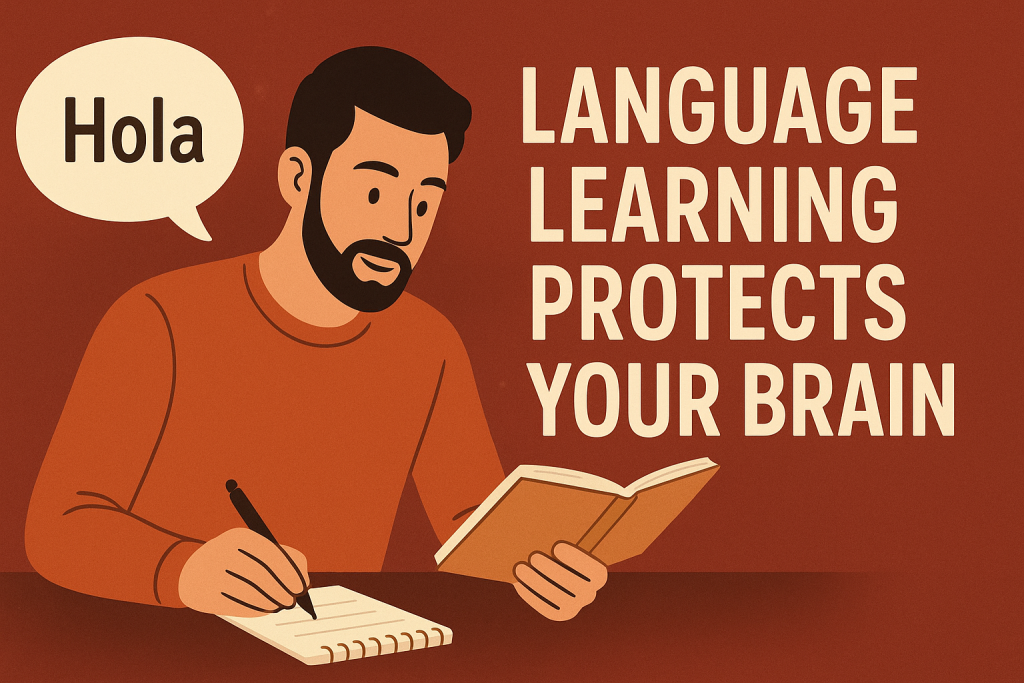
Language learning has evolved far beyond simple communication skills. Modern neuroscience reveals that acquiring a new language fundamentally transforms your brain, creating protective mechanisms against cognitive decline while enhancing mental performance. Whether you’re using Anki flashcards or traditional study methods, your language learning journey is simultaneously building a fortress around your most precious asset: your memory.
The Hidden Power of Bilingualism: More Than Communication
When you embark on learning Spanish, French, Italian, German, or any new language, you’re engaging in one of the most comprehensive brain workouts available. Unlike single-skill activities, language learning activates multiple cognitive systems simultaneously, creating what researchers call “cognitive reserve” – your brain’s ability to maintain function despite age-related changes.
Recent studies tracking thousands of participants over decades reveal remarkable findings. Bilingual individuals consistently demonstrate superior cognitive flexibility, enhanced problem-solving abilities, and most surprisingly, significant protection against age-related memory loss.
Spaced Repetition: The Memory Training System Hidden in Plain Sight
The spaced repetition method – the scientific foundation underlying Anki flashcards – represents one of the most effective memory training protocols ever discovered. When you practice vocabulary flashcards using spaced repetition, you’re not just memorizing words. You’re training your brain’s memory consolidation processes, strengthening the neural pathways responsible for information storage and retrieval.
Each flashcard session becomes a targeted workout for your hippocampus, the brain region crucial for forming new memories and protecting against cognitive decline. Grammar flashcards and pronunciation practice activate multiple brain regions simultaneously, creating multi-sensory memory traces that prove remarkably durable.
Delayed Dementia: The Four-to-Five Year Advantage
Perhaps the most compelling research finding involves language learning’s protective effect against Alzheimer’s disease and dementia. Multiple independent studies consistently show that bilingual individuals develop dementia symptoms approximately 4-5 years later than monolingual counterparts, even when controlling for education and socioeconomic status.
This delay isn’t trivial. Those additional years represent precious time with loved ones, maintained independence, and preserved quality of life. The mechanism appears related to enhanced cognitive reserve – bilingual brains develop alternative neural pathways that can compensate when primary systems begin declining.
Executive Function Enhancement Through Language Switching
Language learning creates unique cognitive demands that strengthen executive function – your brain’s CEO responsible for planning, focus, and multitasking. When you switch between languages or retrieve vocabulary while suppressing interference from other languages, you’re exercising cognitive control mechanisms that transfer to non-linguistic tasks.
Regular practice with flashcards, particularly when learning multiple languages, trains these executive systems and benefits all mental activities.
Building Cognitive Reserve Through Strategic Learning
Every new word learned creates lasting changes in brain structure. Vocabulary acquisition increases gray matter density in language-related brain regions while strengthening connections between areas. These structural changes represent genuine cognitive capital your brain can draw upon during challenging periods.
Grammar flashcards provide particularly potent cognitive training because they require pattern recognition, rule application, and exception management – mental skills that transfer extensively to problem-solving across contexts. The cognitive demands activate prefrontal cortex regions associated with working memory and attention control.
The Pronunciation Advantage
Pronunciation practice represents unique cognitive training that combines motor learning with memory consolidation. When you practice proper pronunciation using IPA symbols or minimal pairs, you’re training precise motor control while strengthening auditory discrimination abilities. This motor-memory combination proves particularly beneficial for overall cognitive health.
Maximizing Brain Benefits: Evidence-Based Strategies
To optimize the cognitive benefits of language learning, research suggests several key approaches:
Consistent Daily Practice: Short, regular sessions prove more beneficial than lengthy, infrequent study periods. Even 15-20 minutes of daily flashcard practice creates measurable cognitive improvements.
Active Retrieval Practice: Simply reviewing flashcards passively provides minimal benefit. Active retrieval – attempting to recall information before checking answers – triggers the memory consolidation processes responsible for cognitive enhancement.
Multi-Modal Learning: Combining vocabulary, grammar, and pronunciation training within unified systems maximizes cognitive benefits. Picture flashcards engage visual processing, audio practice activates auditory pathways, and grammar exercises strengthen analytical thinking.
Technology-Enhanced Cognitive Training
Modern flashcard systems like Anki provide unprecedented opportunities for targeted cognitive training. These platforms implement scientifically-validated learning principles consistently, with spaced repetition algorithms ensuring optimal timing while progress tracking maintains motivation.
The key advantage lies in their ability to integrate multiple learning modalities seamlessly, mirroring natural language use while providing systematic practice necessary for building cognitive reserve.
Long-Term Investment in Brain Health
Language learning represents one of the most accessible and enjoyable forms of cognitive training available. Unlike abstract brain training games with questionable benefits, language skills provide immediate practical value while delivering profound long-term cognitive protection.
The investment required – consistent daily practice using evidence-based methods – pales compared to potential returns. Those additional years of cognitive vitality, enhanced mental performance, and protection against age-related decline represent invaluable returns on your learning investment.
Creating Sustainable Learning Habits
Successful language learners develop sustainable routines that integrate seamlessly into daily life. Whether using morning flashcard sessions, commute-time practice, or evening grammar review, consistency proves more important than intensity for achieving long-term cognitive benefits.
Your Brain’s Best Investment
As neuroscience continues revealing the profound connections between language learning and cognitive health, the evidence becomes increasingly clear: your daily flashcard practice, grammar study, and pronunciation work represent powerful investments in long-term brain health.
Each vocabulary word mastered, grammar rule internalized, and pronunciation refined contributes to growing cognitive reserve that may protect your memory for decades. The language skills you’re developing serve dual purposes – enabling cross-cultural communication while building mental resilience for lifelong cognitive vitality.
Ready to accelerate your language learning journey while maximizing cognitive benefits? Subscribe to SPEAKADA WEEKLY newsletter for expert tips, evidence-based strategies, and innovative techniques that make language learning more effective and enjoyable. Join thousands of smart learners building both linguistic skills and cognitive resilience through strategic Anki flashcard practice and scientifically-optimized methods.
Your brain – and your future self – will thank you for making this investment in cognitive health through language learning. Start building your cognitive reserve today, one flashcard at a time.
Ready to experience the brain-boosting benefits of systematic language learning? Explore Speakada’s comprehensive pronunciation, vocabulary, and grammar flashcards designed to maximize learning efficiency and cognitive development. Available for Spanish, French, Italian, German, English, Dutch, and Polish – your journey toward enhanced brain health starts here.

Learning a new language is one of the most rewarding journeys you can embark on, but it's easy to lose Read more

Every year, millions of people set ambitious New Year's resolutions, only to abandon them within weeks. Studies consistently show that Read more
Learning a new language often feels like an impossible dream when you're juggling work deadlines, family responsibilities, social commitments, and Read more
In our increasingly connected world, the ability to communicate across linguistic boundaries has never been more valuable. While many people Read more