
If you have ever opened a Minimal Pairs deck in Anki and thought, “Wait, am I doing this right?” — you are not alone.
We recently heard from Jennifer, a member of our Speakada community who had used our Italian flashcards ahead of a trip to Sicily. She came back glowing, which made our day. But she had also just purchased the Spanish bundles and ran into something confusing with the Minimal Pairs deck: clicking on the desktop felt like nothing was happening, and on her iPhone she was getting a “missing file” error when trying to play audio.
Her experience gave us a great opportunity to explain how Anki minimal pairs flashcards actually work — because they are intentionally designed differently from what most language apps have trained us to expect.
Whether you are working through Anki Spanish Flashcards, Anki French Flashcards, Anki Italian Flashcards, Anki German Flashcards, Anki Dutch Flashcards, Anki Polish Flashcards, or Anki English Flashcards — this guide applies to you.
First: What Are Minimal Pairs?
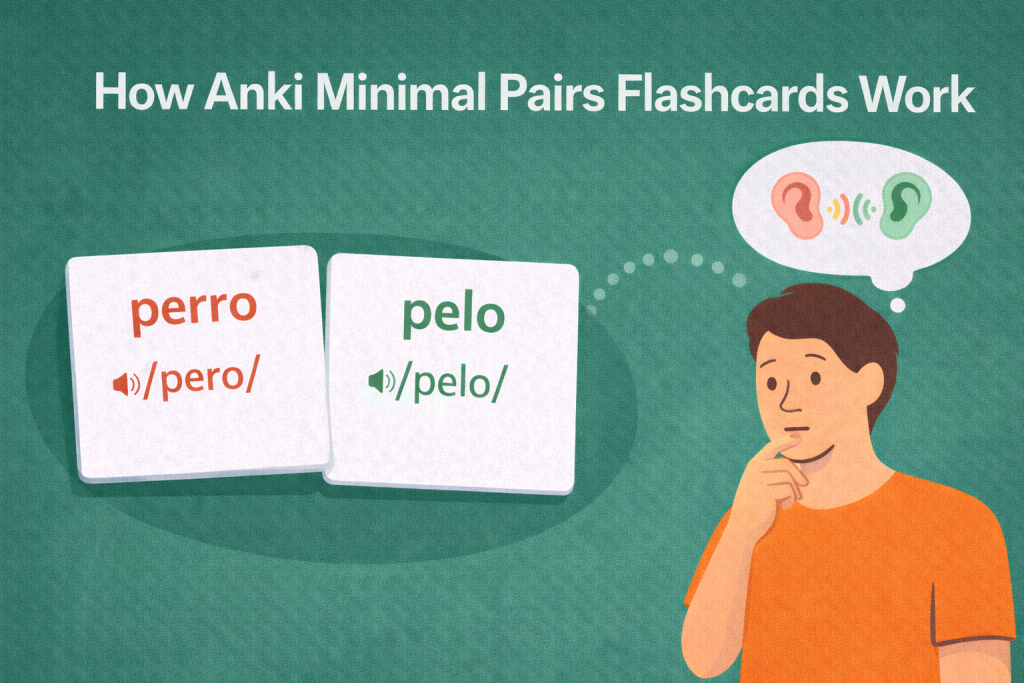
Minimal pairs are two words that sound almost identical but differ by just a single sound. In Spanish, a classic example is perro (/ˈpero/) meaning dog and pelo (/ˈpelo/) meaning hair. Those two words look almost the same on paper and sound nearly identical to an untrained ear — yet they mean completely different things. In French, it might be vin (wine) versus bain (bath). In Italian, fato (fate) versus fatto (fact).
Getting these wrong — or simply not hearing the difference at all — can lead to genuine misunderstandings in real conversation. Practicing minimal pairs sharpens both your listening comprehension and your pronunciation accuracy, because you cannot accurately reproduce a sound you cannot yet hear.
That is exactly what the Pronunciation Flashcards in our Minimal Pairs decks are built to fix.
What Is Inside the Minimal Pairs Deck?
Let’s use the Spanish deck as a concrete example, since that is what Jennifer was working with — though the structure is the same across all languages.
The Spanish Minimal Pairs Flashcards contain 348 flashcards covering 174 Spanish minimal pairs examples, with two card types for each pair. Every card includes:
- Both words of the pair displayed side by side
- The IPA phonetic transcription for each word, so you know exactly how each sound is formed
- Native-speaker audio for both words, so you can train your ear on the real sounds
The minimal pair words were not chosen randomly. Speakada analyzed the top 10,000 most frequently used Spanish words and used a proprietary process to identify pairs of words that differ by just one sound. That means as you practice pronunciation, you are simultaneously becoming familiar with the vocabulary that matters most in everyday Spanish — two learning goals in one deck.
The deck is rated as Easy / Beginner level and takes approximately two to three months to complete at a comfortable pace. It is available exclusively as part of the Spanish Pronunciation Bundle.
The same approach — IPA, native audio, frequency-sourced word pairs — runs through every language we cover. So whether you are after the French Pronunciation Bundle, Italian Pronunciation Bundle, German Pronunciation Bundle, Dutch Pronunciation Bundle, Polish Pronunciation Bundle, or English Pronunciation Bundle, you get the same rigorous, frequency-based methodology.
Why Not Just Make Your Own?
You can, of course, create your own Anki minimal pairs deck for free. But consider the reality: creating a single Anki card from scratch takes around three minutes on average. The Spanish Minimal Pairs deck alone has 348 cards. That is roughly 17 hours of card creation before you have studied a single word — and that does not include sourcing native audio, learning IPA, or figuring out the card formatting.
Our pre-made decks let you skip straight to the actual learning.
Why Anki Is Not Like Duolingo (and Why That Is a Good Thing)
Here is where most newcomers get tripped up. Anki does not work like Duolingo, Babbel, or other gamified language apps where you tap a button and it immediately glows green or red.
Anki is built around spaced repetition and active recall — a learning method with decades of cognitive science behind it. The point is not to reward button-clicking. The point is to create a genuine mental commitment before the answer is revealed, because that is where the learning actually happens.
If you want to understand more about why this system is so effective, check out How Anki Works to Learn a Language Better and Why Anki is Good for Learning.
How to Use a Minimal Pairs Card Correctly
Here is the step-by-step process for using any Speakada Minimal Pairs deck, whether it is the Spanish Minimal Pairs Flashcards, French Minimal Pairs Flashcards, German Minimal Pairs Flashcards, Italian Minimal Pairs Flashcards, Dutch Minimal Pairs Flashcards, or Polish Minimal Pairs Flashcards:
Step 1 — The card appears. You will see two minimal pair words displayed side by side, along with their IPA phonetic transcription and audio for each word.
Step 2 — Listen and read. Play the audio prompt and read both words carefully. The goal is to hear the distinction between the two sounds.
Step 3 — Make a mental commitment. This is the most important step. Before pressing anything, commit in your mind to which word you think is being tested. Say it to yourself: “I think it is the left one.” This mental selection is the active recall moment — the heart of Anki’s learning method.
Step 4 — Press Spacebar (or click Show Answer). The card will now reveal the correct answer using color coding, so you can immediately see whether you were right.
Step 5 — Rate yourself. Use the Again, Hard, Good, or Easy buttons to tell Anki how well you knew the answer. This is what drives the spaced repetition engine, bringing harder cards back sooner and easier cards less frequently.
The reason there is no click-to-select button before the answer is revealed is entirely deliberate. If a card registered your click as your answer before showing the solution, it would conflict with Anki’s built-in rating system. The mental selection is the test. The reveal is the feedback. The gap between the two is where the learning takes root.
Mobile Issues: Make Sure You Have the Right App
Jennifer was also seeing a “missing file” error on her iPhone when trying to play audio. This is a separate issue, and it is worth flagging for everyone.
The App Store has several lookalike apps — AnkiApp, AnkiPro, and others — that have similar names and icons but are not the official Anki application. They do not support the audio files, IPA formatting, or color-coded card design that our decks are built with, which causes exactly the kind of errors Jennifer described.
The correct app is AnkiMobile Flashcards — it has a blue star icon on a grey background. You can confirm you have the right app by checking the official Anki website at ankiweb.net. It is a paid app on iOS (around $25 USD), and that purchase directly funds ongoing open-source development of the free desktop version.
If you already have the correct app and are still seeing errors, the most likely culprit is that the media files have not finished syncing yet. Our pronunciation decks contain a lot of audio files. Open the app, tap Synchronize, and wait for the progress bar to complete fully before opening your deck — this can take a few minutes on a first sync.
Tips for Getting the Most from Minimal Pairs Practice
Getting the mechanics right is just the start. Here are a few habits that will make your minimal pairs sessions significantly more effective:
Do not rush the reveal. Give yourself a genuine pause after the audio plays. The discomfort of not knowing immediately is the productive part.
Replay both words after the reveal. After the correct answer is shown, listen to both words again. This trains your ear to lock in the exact difference in sound, not just remember which answer was correct this time.
Rate difficult pairs as Again. If a pair keeps tripping you up, press Again. Anki will bring it back sooner. Trying to skip past difficult cards defeats the purpose of the system.
Build your foundation first. We recommend completing the Alphabet and IPA decks before starting Minimal Pairs. Our Spanish IPA Flashcards, French IPA Flashcards, Italian IPA Flashcards, German IPA Flashcards, Dutch IPA Flashcards, Polish IPA Flashcards, and English IPA Flashcards are designed to tune your ear before you tackle near-identical sounds. When you already understand the IPA symbols and how your target language’s sounds map to them, minimal pairs training clicks into place much faster.
Pair it with vocabulary and grammar work. Pronunciation means nothing in isolation. Combine your minimal pairs practice with Vocabulary Flashcards and Grammar Flashcards for a complete, well-rounded approach to language acquisition.

What This Looks Like Across All Our Languages
Jennifer’s Sicily story is a perfect reminder of what deliberate pronunciation practice makes possible in the real world. The ability to hear and produce the right sounds does not just make you more accurate — it makes you more confident, more natural, and more understood.
The same applies whether you are heading to Paris, Berlin, Amsterdam, Kraków, or anywhere else where these languages are spoken.
If you want to explore everything available for your target language, here are the best starting points:
- Best Spanish Anki Decks That You Need Now
- Best French Anki Decks That You Need Now
- Best Italian Anki Decks That You Need Now
- Best German Anki Decks That You Need Now
- Best Dutch Anki Decks That You Need Now
- Best Polish Anki Decks That You Need Now
- Best English Anki Decks That You Need Now
Get More Tips Like This Every Week
If this article helped clarify how our Minimal Pairs decks work, you will love what we send out regularly through Speakada Weekly — our free newsletter packed with practical tips, learning strategies, and Anki insights for language learners at every level.
👉 Sign up for the Speakada Newsletter and join a community of smart language learners who are using Anki the right way.
No fluff. No filler. Just the kind of ideas that actually move the needle.
Questions? We Are Here
If you ever have a question about how any of our decks work — whether it is a technical issue like Jennifer’s or just a question about study strategy — reply to any of our emails or visit the Anki Language Learning Blog for more guides like this one.
Every message gets read. Every question is worth asking.
Explore all our Anki Language Learning Flashcards or learn more about how our decks are built.
Make Flashcards Online to Learn Spanish Now One of the biggest challenges when learning Spanish is figuring out how to Read more
Most language learners aim for 10 Anki cards per day — but is that right for you? Discover the 3 Read more
Cloze Deletion Anki Guide - My Experience and What I Use Now In this article, I'm going to be talking Read more
Grammatical Gender and How to Learn Gender Nouns With Anki Recently we were asked a question about the use of Read more