
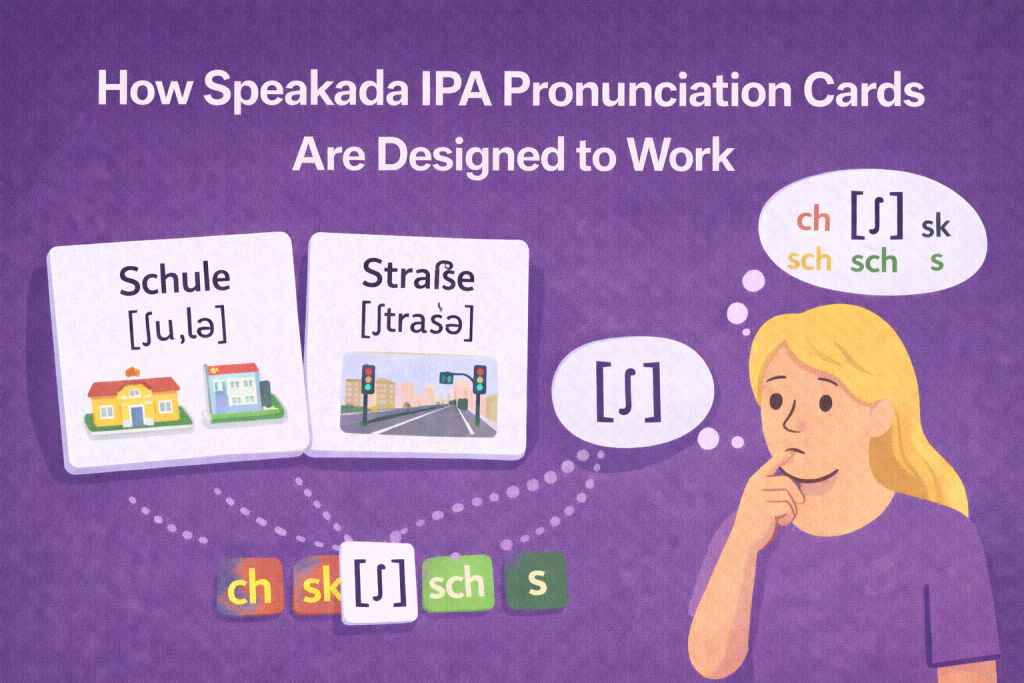
A question from one of our German learners sparked this deep dive into how IPA Pronunciation Cards actually work — and why “ambiguity” is a feature, not a flaw.
One of the most rewarding parts of running Speakada is hearing from our language learning community. Recently, James — a learner working through the German Pronunciation Bundle — sent us a sharp, genuinely thoughtful question about his German IPA Flashcards.
He’d noticed something that felt off. While studying the IPA Pronunciation Cards, he came across the sound [ʃ] — and realized it could correspond to several different spellings: ch, sch, sk, or s, depending on the word. His concern was understandable:
“If there are multiple possible answers, isn’t the card pointless?”
It’s exactly the kind of question that gets to the heart of language learning methodology. And it deserves a real, thorough answer.
What IPA Pronunciation Flashcards Are Actually Designed to Do
Let’s start with a foundational truth: IPA Pronunciation Cards are not phoneme-to-grapheme matching drills.
They are not designed to teach you that [ʃ] always equals sch, or that [k] always equals k. In real language, that’s simply not how sounds and spellings work — in any language. And if you’ve ever tried to memorize rigid one-to-one mappings, you already know how quickly that system breaks down the moment you encounter a new word.
Instead, Pronunciation Flashcards are designed to do something far more valuable:
They help you recognize the relationship between IPA sounds and their various spelling representations in the context of real words.
This is not a subtle distinction. It’s the entire pedagogical foundation of how these cards work.
When you see a card for the sound [ʃ] paired with the German word Schule and its audio, you’re not just being asked to parrot a symbol. You’re building a mental model of how that sound behaves — what it sounds like, where it typically appears, what spellings it tends to wear in German. Repeat that process across dozens of words and card types, and you build pattern recognition that transfers to new vocabulary automatically.
That’s the goal. And it’s exactly what Anki Language Learning Flashcards are designed to achieve through spaced repetition.
Why Context Isn’t “Giving Away the Answer” — It’s the Answer
James’s concern was that the vocabulary and images on each card were “changing the objective” from ear training to vocabulary learning. This is a really interesting way to frame it — and it’s worth unpacking.
Here’s the key insight: sounds don’t exist in a vacuum. They exist in words. And words carry context.
Think about how a musician learns. They don’t just memorize isolated notes — they learn how those notes function within chords, keys, and musical progressions. A C note means something different in a C major chord than it does in an A minor chord. Stripping away that context doesn’t produce a deeper understanding of the note — it produces an incomplete one.
Language works the same way. When you hear the sound [ʃ] in isolation, you’re hearing a phonetic abstraction. When you hear it in Schule (school) or Straße (street), you’re hearing how German actually sounds — and you’re building the kind of contextual, pattern-based knowledge that allows you to recognize and produce that sound correctly in new situations.
The vocabulary and images on each card aren’t accessories. They’re the linguistic scaffolding that makes the pronunciation pattern meaningful and memorable. This is intentional design rooted in how language acquisition actually works.
This Applies to Every Language We Teach
James was working through his German decks, but this same principle holds true across every language in our catalog.
Consider a few examples:
- Spanish: The letter c represents the sound [k] before a, o, u, but [s] (or [θ] in Spain) before e and i. Our Anki Spanish Flashcards teach these patterns in context — not as isolated, abstract rules.
- French: The sound [ɔ̃] can be spelled on, om, un in certain positions, and French liaison rules add another layer of complexity. Our Anki French Flashcards place these sounds in real words so your brain learns the feel of the patterns.
- Italian: The combination gli produces a sound unlike anything in English. Our Anki Italian Flashcards use contextual examples precisely because that sound needs to be heard within words to be properly internalized.
- Dutch: With sounds like g, ch, and ij, Dutch pronunciation is notoriously tricky for English speakers. Our Anki Dutch Flashcards build the same contextual sound-spelling awareness that helps you stop second-guessing yourself.
- Polish: Polish orthography is actually quite consistent — but sounds like cz, sz, ż, rz can throw beginners completely. Our Anki Polish Flashcards walk you through these patterns with real-word examples that make the system click.
In every one of these languages, a sound can have multiple spelling representations depending on context. That’s not a bug in the language — and it’s not a bug in the flashcards. It’s the nature of human language, and the cards are designed to meet you where the language actually lives.
The Design Philosophy Behind Speakada’s Pronunciation Decks
When we built our Pronunciation Flashcards, we made a deliberate choice to prioritize pattern recognition over rote memorization.
Here’s what that means in practice:
1. Each card contains an IPA symbol, a real word, a pronunciation audio, and a contextual image.
This combination engages multiple cognitive channels at once — visual, auditory, and semantic. Research on language acquisition consistently shows that multi-modal learning leads to stronger memory retention. When you hear the sound, see the word, read the IPA symbol, and associate it with a memorable image, you’re building a richer, more durable memory trace than you would from any single input alone.
2. The cards use three different card types for each sound.
Rather than asking the same question the same way every time, the deck rotates through different formats: recognizing the sound, identifying the spelling, and thinking up the correct answer. This variety keeps your brain engaged and ensures you’re building flexible knowledge — not just the ability to pattern-match in one specific format.
3. The goal is fluency, not accuracy on a specific card type.
Ultimately, what you want from learning pronunciation is the ability to hear a word and know how to say it — and to see a word and know how it sounds. That requires understanding the relationships between sounds and spellings across contexts. That’s exactly what these cards train.
How to Use IPA Pronunciation Flashcards Most Effectively
If you’re working through IPA Pronunciation Cards — whether in our Spanish Pronunciation Bundle, French Pronunciation Bundle, Italian Pronunciation Bundle, or any other language — here are a few tips to get the most out of them:
Focus on the sound, not the spelling. When a card plays an audio clip, your first job is to really listen — notice the quality of the sound, where it’s produced in your mouth, how it feels different from sounds in your native language. The spelling will come with exposure.
Use the images as anchors. The image on each card isn’t decoration — it’s a memory hook. When you can associate the sound [ʃ] with a visual of a Schule (school), you’re giving your brain something to grab onto when that sound comes up in new vocabulary.
Don’t worry about “getting it right” immediately. Anki’s spaced repetition algorithm will keep showing you the cards you struggle with until they stick. Trust the process. The point of early reviews is exposure, not perfection.
Say the sound out loud. Pronunciation is a physical skill. Even when reviewing on your own, actually producing the sound — not just recognizing it — accelerates your progress dramatically. Pair your deck reviews with our Speaking Fluency Practice tool for even better results.

Questions Like James’s Make Our Products Better
We genuinely love hearing from our community. Questions like James’s help us explain our design decisions more clearly — and challenge us to think harder about how we communicate the purpose of each card type.
If you’ve ever wondered why a card works a certain way, or had a question about how to get more out of your deck, don’t hesitate to reach out. Every message is read personally, and many of our best improvements have come directly from learner feedback.
You can also explore more tips, tricks, and language learning strategies on our Anki Language Learning Blog — we publish regularly on topics ranging from how to learn vocabulary faster to how to learn grammar fast.
Ready to Build a Solid Pronunciation Foundation?
If you’re not yet using IPA Pronunciation Flashcards as part of your language learning routine, now is a great time to start. Pronunciation is the foundation that everything else — vocabulary, grammar, listening comprehension — is built upon. Get it right early, and every other part of your learning accelerates.
Browse our pronunciation decks by language:
- Spanish Pronunciation Bundle
- French Pronunciation Bundle
- Italian Pronunciation Bundle
- German Pronunciation Bundle
- Dutch Pronunciation Bundle
- Polish Pronunciation Bundle
- English Pronunciation Bundle
Or browse by flashcard type — including Vocabulary Flashcards, Grammar Flashcards, and our full suite of Anki Language Learning Flashcards.
Want More Tips Like This? Subscribe to Speakada Weekly
If you found this article useful, you’ll love Speakada Weekly — our free newsletter where we share smart, practical language learning strategies, Anki tips, and insights from our community every week.
No fluff. No filler. Just actionable advice to help you learn smarter and reach fluency faster.
👉 Sign up for the Speakada Newsletter here — it’s free, and you can unsubscribe anytime.
Have a question about how our flashcards work? Reach out at info@speakada.com — we read every message.
How to Speak With a German Accent When you begin to learn German, there are so many elements that you Read more
How to Pronounce German Words and Learn German Now Although the German language is similar to English in some respects, Read more
Anki is a highly effective tool for learning a new language, and it is often used by students as a Read more
As the new year is here, you might be thinking about setting a goal to really learn German. Although learning Read more