
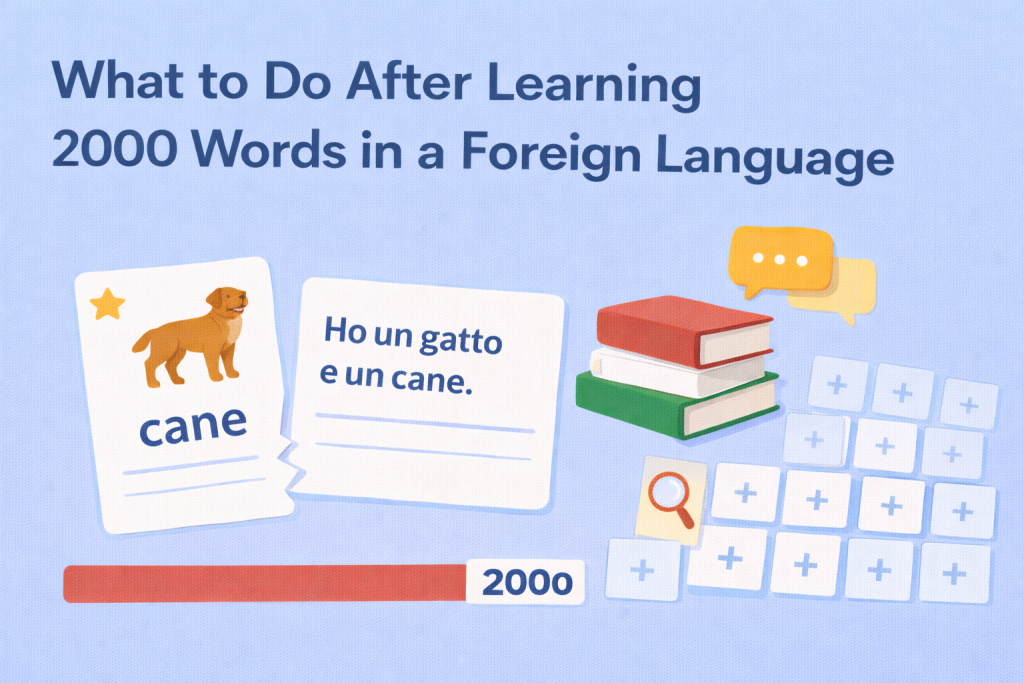
A Speakada community member recently finished the Italian Top 2000 Words deck and asked a question that thousands of language learners reach eventually — what comes next? Here’s the honest answer.
The 2000-Word Milestone: A Bigger Deal Than You Think
John, one of our Speakada community members, sent us a message after working through the Italian Top 2000 Words Flashcards:
“I’d like to know if you have a program for the next 2000 words, assuming I learn the 1st 2000!”
It’s one of the most common — and most insightful — questions we receive. And the answer might surprise you.
First, let’s acknowledge what reaching 2000 high-frequency words actually means. Linguists and language acquisition researchers generally agree that the top 2000 most common words in any language account for roughly 90% of everyday conversation. That’s an enormous amount of ground covered. You can understand the bulk of what you read, hear, and need to say in everyday situations.
John’s milestone isn’t just progress — it’s a turning point. And it applies whether you’re learning Italian, Spanish, French, German, Dutch, Polish, or English. The same principles hold across every language.
So — what do you do next?
Why “More Vocabulary” Isn’t Always the Right Answer
It’s tempting to think: if 2000 words got me this far, another 2000 will take me even further. Mathematically, that feels right. But the reality of language acquisition is a little different.
The first 2000 high-frequency words give you massive bang for your buck because they appear constantly — in every conversation, article, and sentence you encounter. Words 2001–4000? Still useful, but they appear far less often. The return on your study time starts to shrink.
This phenomenon is sometimes called the law of diminishing returns in vocabulary learning. After the high-frequency core, you get better results by learning new words in context — from real content you’re actually consuming — rather than from a structured frequency list.
So rather than a “next 2000 words” deck, here’s what we actually recommend.

3 Smart Paths Forward After the Top 2000 Words
Path 1: Learn Common Phrases to Start Speaking Naturally
Knowing 2000 words and speaking fluently are two very different things. If you’ve picked up the Spanish Vocabulary Bundle, French Vocabulary Bundle, or the equivalent for your language, you likely already have access to the Common Phrases deck — and this is often the most underused resource learners have.
Common phrases bridge the gap between knowing words in isolation and actually stringing them together the way native speakers do. Real conversations aren’t built from single vocabulary words — they’re built from patterns, expressions, and phrases that native speakers use every day.
- Spanish Common Phrases Flashcards
- French Common Phrases Flashcards
- Italian Common Phrases Flashcards
- German Common Phrases Flashcards
- Dutch Common Phrases Flashcards
- Polish Common Phrases Flashcards
- English Common Phrases Flashcards
If you want to sound less like a textbook and more like a real speaker, this is one of the highest-leverage moves you can make right now.
Path 2: Move into Grammar Flashcards — and Unlock Everything You Already Know
This is where most learners experience the biggest leap toward actual fluency.
Here’s why: after learning 2000 vocabulary words in their root forms, most learners know what the words mean — but not how to use them. Grammar is the instruction manual for your vocabulary. It teaches you tenses, conjugations, sentence structures, and the rules that let you produce real sentences — not just recognize words.
Think of it this way: your vocabulary deck gave you 2000 puzzle pieces. Grammar flashcards show you how to assemble them.
Matthew’s reply to John put it perfectly: the Italian Grammar Bundle shows you how to use those 2000 words in various conjugations, grammatical structures, and phrasal verbs — multiplying your ability to actually use those words in real sentences.
We offer Grammar Flashcards from beginner to advanced (A0 through C1 CEFR levels) for multiple languages:
Italian:
- Italian Beginner Grammar Flashcards (A0-A2)
- Italian Intermediate Grammar Flashcards (B1-B2)
- Italian Advanced Grammar Flashcards (C1)
- Italian Grammar Flashcards Bundle
Spanish:
- Spanish Beginner Grammar Flashcards (A0-A2)
- Spanish Intermediate Grammar Flashcards (B1-B2)
- Spanish Advanced Grammar Flashcards (C1)
- Spanish Grammar Bundle
French:
- French Beginner Grammar Flashcards (A0-A2)
- French Intermediate Grammar Flashcards (B1-B2)
- French Advanced Grammar Flashcards (C1)
- French Grammar Bundle
Path 3: Dive into Real Input — and Build Your Own Custom Decks
At the 2000-word level, you’re ready to start engaging with your target language in the wild. Books, podcasts, films, YouTube channels, news websites — all of it becomes far more accessible once you have the core vocabulary under your belt.
This approach, often called comprehensible input, is one of the most powerful ways to keep expanding your vocabulary beyond 2000 words. Here’s why it works so well: instead of learning words from a frequency list, you’re learning words that are directly relevant to your life, your interests, your work, and your conversations. That personal relevance makes the vocabulary stick much better.
The key habit to build at this stage? Create your own custom Anki flashcards as you go.
Every time you encounter a word you don’t know — in a podcast, article, or conversation — add it to your personal Anki deck. Focus on words that keep appearing, or that are directly useful in your daily life. Over time, this turns every episode of your favourite podcast or chapter of your favourite novel into a personalised vocabulary lesson.
If you want a quick way to get started, our free Online Flashcard Maker makes it easy to create custom Anki cards without the usual setup headache.
You might also find our Speaking Fluency Practice tool helpful — it’s designed to help you practise actually using the vocabulary and grammar you’ve been building.
The Bigger Picture: A Language Learning Roadmap That Works
For anyone wondering about the full journey, here’s a simple framework that works across all the languages Speakada supports:
- Pronunciation first — Use Pronunciation Flashcards (alphabet, IPA, and minimal pairs) to build a solid foundation of sounds before anything else.
- Core vocabulary — Work through the Vocabulary Flashcards (500 picture words → top 2000 words → common phrases).
- Grammar — Use Grammar Flashcards to transform your passive vocabulary into active fluency.
- Real-world input — Consume media, books, and conversations in your target language, and use custom Anki decks to capture new vocabulary as you go.
If you’ve completed the Top 2000 Words, you’re at step 3 (or even step 4). That’s a genuinely impressive place to be.
Don’t Forget: Why Anki Works So Well for This Entire Journey
Every step of this process works better with Anki because of how Spaced Repetition Systems work. Anki shows you flashcards at the exact moment your brain is about to forget them — which means you spend less time reviewing things you already know and more time reinforcing things that need attention.
That’s why Anki is so effective for language learning. It doesn’t just help you learn words — it helps you keep them, long-term, with minimal wasted effort.
The challenge most learners face is the setup time. Creating cards with audio, images, and IPA pronunciation guides is genuinely tedious. That’s exactly why Speakada exists — to give you professionally designed, ready-to-use Anki Language Learning Flashcards so you can focus on learning, not card creation.
Ready for Your Next Step?
Whether you’re in John’s shoes (freshly finished with 2000 Italian words) or somewhere else on your journey, there’s a clear path forward.
Browse our full range of decks for your language:
- 🇪🇸 Anki Spanish Flashcards
- 🇫🇷 Anki French Flashcards
- 🇮🇹 Anki Italian Flashcards
- 🇩🇪 Anki German Flashcards
- 🇳🇱 Anki Dutch Flashcards
- 🇵🇱 Anki Polish Flashcards
- 🇬🇧 Anki English Flashcards
Not sure which deck is right for you? Check out our curated recommendations:
- Best Spanish Anki Decks That You Need Now
- Best French Anki Decks That You Need Now
- Best Italian Anki Decks That You Need Now
- Best German Anki Decks That You Need Now
Want More Tips Like This? Subscribe to Speakada Weekly
Every week, we send out practical, no-fluff tips for learning languages smarter with Anki flashcards — just like the advice in this article.
If you found this post helpful, you’ll love the Speakada Weekly newsletter. It’s where we share our best strategies for vocabulary building, pronunciation, grammar, and everything in between — straight to your inbox, for free.
👉 Sign up for the Speakada Newsletter here — it’s free, and you can unsubscribe any time.
How to Learn Vocabulary in a Smart and Effective Way Embarking on a journey to master a new language is Read more
Learning a new language can feel overwhelming when you consider that most languages contain hundreds of thousands of words. But Read more
Learning a new language is one of the most rewarding journeys you can embark on, but it's easy to lose Read more
Every year, millions of people set ambitious New Year's resolutions, only to abandon them within weeks. Studies consistently show that Read more