
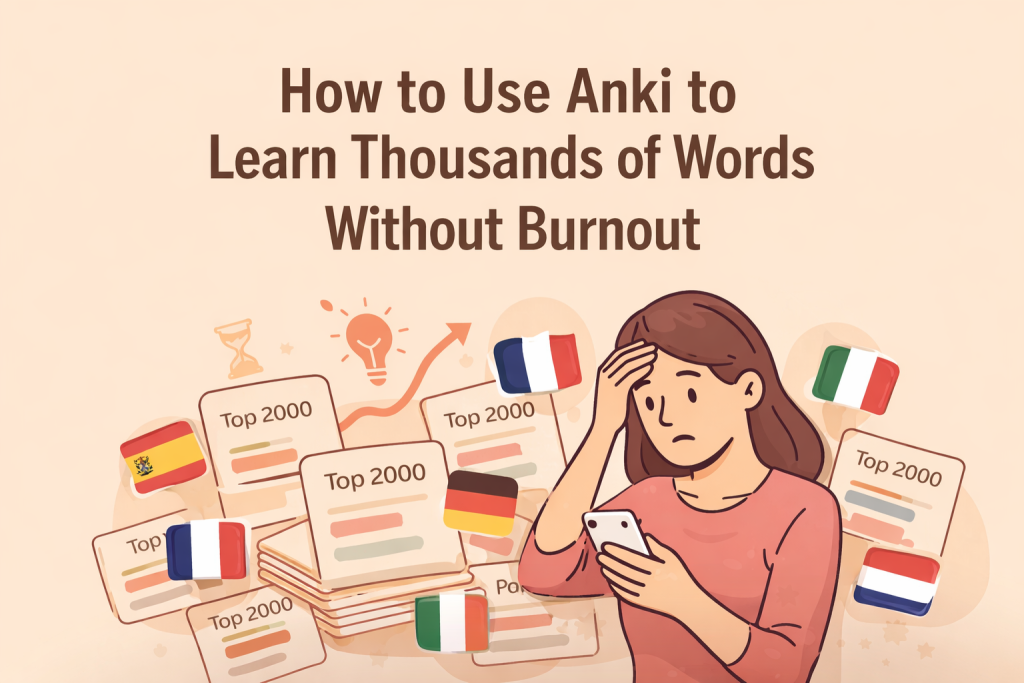
You’ve just downloaded an Anki language learning flashcard deck containing the top 2000 most common words in your target language. You open it up, see that massive number staring back at you, and suddenly feel a wave of anxiety wash over you.
“Do I have to learn all of this at once?”
If you’ve ever felt this way, you’re not alone. This feeling of vocabulary overwhelm is one of the most common challenges language learners face, whether they’re studying Spanish, French, German, Italian, English, Dutch, or Polish.
Recently, one of our Speakada community members, Russell, sent us a question that perfectly captures this concern. His question sparked an important conversation about how to approach large vocabulary decks effectively, and today we’re going to break down the exact strategy that will help you learn thousands of words without burning out.
Russell’s Question: The Chunking Problem
Russell asked us something that many language learners wonder about but rarely voice:
“Are they separated in chunks? I assume so, but what size are the chunks? I ask this since I wouldn’t think I would want it shuffling all 2000 most common words to start. I would think I would want to approach them in increments…”
This is an incredibly insightful question. Russell instinctively understood something crucial about effective language learning: trying to drink from a firehose usually ends up with you getting wet, not hydrated.
The concern is valid. When you’re learning a new language, facing 2000+ words all at once can feel paralyzing. But here’s the good news: with the right approach to organizing and pacing your studies, those intimidating numbers become completely manageable.
The Problem with Vocabulary Overwhelm
Before we dive into solutions, let’s understand why vocabulary overwhelm happens and why it’s so detrimental to your language learning journey.
When learners try to tackle too much vocabulary at once, several problems emerge. First, cognitive overload sets in. Your brain simply can’t process and retain dozens of new words simultaneously. Second, motivation plummets. Nothing kills language learning enthusiasm faster than feeling like you’re making no progress despite hours of study. Third, retention suffers dramatically. Without proper spacing and review, those words you crammed yesterday will be forgotten by next week.
The solution isn’t to avoid large vocabulary flashcards altogether. High-frequency vocabulary decks are incredibly valuable because they teach you the words that appear most often in real-world communication. Instead, the solution lies in how you approach these decks.
The Speakada Roadmap: Your Step-by-Step Learning Path
The first thing to understand is that quality Anki flashcards aren’t just one giant pile of random words. At Speakada, our cards are carefully organized into specific decks within our bundles, creating a natural progression that prevents overwhelm.
Here’s the recommended learning sequence that works across all languages we offer:
Step 1: Start with Picture Words
Begin your journey with 500 picture word flashcards. These are concrete nouns like “table,” “dog,” “apple,” and “car” that are easy to visualize and remember. Because these words connect to physical objects you can see and touch, your brain forms stronger memory associations.
Why start here? Concrete vocabulary forms the foundation of language learning. These words appear constantly in everyday conversation, and the visual element makes them significantly easier to retain than abstract concepts. Whether you’re using Spanish 500 Picture Words Flashcards, French 500 Picture Words Flashcards, or picture word decks in any other language, this creates a solid base.
Step 2: Move to Common Phrases
Once you’ve built a foundation of concrete vocabulary, transition to common phrases. This step gets you speaking and understanding real context immediately. Instead of just knowing individual words, you’ll learn how native speakers actually combine those words in daily conversation.
Common phrase decks teach you practical expressions like greetings, questions, responses, and everyday interactions. This is where language learning shifts from memorizing vocabulary to actually communicating. Your German Common Phrases Flashcards or Italian Common Phrases Flashcards will give you conversation-ready language that you can use immediately.
Step 3: Tackle the Top 2000 Words
Now you’re ready for the big leagues. The top 2000 words in any language cover roughly 80-90% of everyday communication. This deck fills in the gaps with abstract words, connectors, prepositions, and less visual vocabulary that holds language together.
Because you’ve already learned concrete nouns and common phrases, these abstract words now have context. You’re not learning them in isolation; you’re adding them to an existing framework. Decks like Spanish Top 2000 Words Flashcards or Dutch Top 2000 Words Flashcards become much more manageable when approached after establishing your foundation.
Bonus: Grammar Integration
If you’re using Grammar Flashcards, simply work from the easiest CEFR levels (A1/A2) up to the hardest (C1). Grammar learning follows the same principle: build complexity gradually rather than jumping into advanced concepts before you’re ready.
The Secret Weapon: Frequency-Based Organization
Here’s something crucial that Russell might not have realized: even within a specific deck, you’re not learning random words. Quality Anki decks organize cards by frequency and usefulness.
What does this mean practically? When you study the top 2000 words, you’ll always encounter the most common words first. You’re not randomly shuffling between word #1 (the most common) and word #1,847 (much less common). The deck is intelligently sequenced so you’re constantly learning the vocabulary that gives you the most “bang for your buck.”
This frequency-based approach means your first 100 words will have dramatically more real-world utility than words 1,900-2,000. You’ll be able to understand and participate in basic conversations long before you’ve “finished” the entire deck.
You Control the Flow: Mastering New Cards Per Day
This is where Anki’s true power emerges, and where you solve the overwhelm problem completely. You don’t have to study all 2000 words on Day 1. In fact, you shouldn’t.
Anki allows you to set exactly how many “New Cards Per Day” you want to see. This single setting is your volume control on the language learning firehose Russell was worried about.
Starting Small: The Goldilocks Zone
For most learners, starting with 5-20 new cards per day hits the sweet spot. This range is large enough to make consistent progress but small enough to avoid overwhelming your working memory.
Consider that 10 new cards per day equals 3,650 words per year. Even at just 5 cards daily, you’d learn 1,825 words annually. That’s nearly the entire high-frequency vocabulary of a language, learned sustainably.
A Real Example: The 6-Card Strategy
Want to know what works in practice? The founder of Speakada currently studies just 6 new cards per day. It might sound almost comically slow, but here’s the math: 6 cards daily equals 2,190 words per year.
This modest pace has a hidden advantage: consistency beats intensity every single time. It’s better to study 6 cards every day for a year than to study 50 cards daily for two weeks before burning out and quitting.
The 6-card approach also leaves plenty of mental energy for reviewing old cards. Remember, Anki isn’t just about learning new words; it’s about reviewing words at optimal intervals to move them into long-term memory. When you’re only adding 6 new cards daily, your review sessions remain manageable even as your deck grows.
Adjusting Your Pace
Your ideal new cards per day setting depends on several factors:
- Available study time: If you can only dedicate 15 minutes daily, stick with 5-10 new cards. If you have an hour, you might handle 20-30.
- Learning intensity: Are you preparing for immersion or casual learning? Imminent travel might justify temporarily increasing your new card count.
- Current workload: Other life responsibilities matter. A student on summer break has different capacity than a working parent.
- Language difficulty: Languages closer to your native language might allow higher new card counts than more distant languages.
The beauty of Anki is you can adjust this setting anytime. Start conservative, see how it feels, and adapt accordingly.
The Suspend Button: Your Efficiency Tool
Here’s another Anki feature that prevents overwhelm: the suspend button. If a card is too easy (maybe you already knew that word), you can suspend it to remove it from your rotation.
Why does this matter? Because not every card in a 2000-word deck will be equally unfamiliar. You might already know 200-300 words from previous exposure, cognates, or shared roots with your native language. Suspending these cards keeps your study sessions focused on words that actually need your attention.
This is particularly useful for learners who aren’t complete beginners. If you’re using French Vocabulary Bundle or Polish Vocabulary Bundle and already have some foundation in the language, suspending known words ensures you’re spending time efficiently.

This Strategy Works Across All Languages
Whether you’re tackling Anki Spanish Flashcards, Anki French Flashcards, Anki German Flashcards, Anki Italian Flashcards, Anki Dutch Flashcards, Anki Polish Flashcards, or Anki English Flashcards, these principles remain constant.
The human brain doesn’t process Spanish differently than it processes Dutch. The same cognitive principles apply: spaced repetition works, manageable chunks prevent overwhelm, and consistency outperforms cramming.
The only variables are the specific vocabulary items and grammatical structures of each language. The learning methodology stays the same.
Pronunciation: The Often-Forgotten Element
While we’re discussing vocabulary learning, don’t neglect pronunciation. Many learners focus exclusively on meaning and spelling, then struggle to recognize words in conversation or pronounce them correctly.
Quality vocabulary decks should include audio recordings of native speakers. If you’re using comprehensive bundles, consider also incorporating Pronunciation Flashcards that specifically target sound distinctions in your target language.
Spanish Minimal Pairs Flashcards, French Minimal Pairs Flashcards, German Minimal Pairs Flashcards, and similar resources help you distinguish between similar-sounding words that differ by just one sound. This prevents embarrassing mix-ups and improves your listening comprehension dramatically.
Building Your Long-Term Learning Habit
Russell’s question about chunks reveals a deeper wisdom: he’s thinking long-term. He understands that sustainable learning trumps short-term heroics.
This mindset is exactly what separates successful language learners from those who quit after a few weeks. The goal isn’t to sprint through 2000 words in a month. The goal is to build a daily habit that steadily expands your vocabulary month after month, year after year.
Think of learning vocabulary faster like compound interest. Small daily deposits create enormous returns over time. Six words per day seems insignificant on Tuesday afternoon, but multiplied across hundreds of days, it transforms your language ability.
Tracking Your Progress Without Obsessing
While consistency matters more than speed, monitoring your progress helps maintain motivation. Anki provides helpful statistics showing your daily review counts, retention rates, and learning streaks.
However, resist the temptation to compare your pace with others. Someone studying 30 new cards daily isn’t necessarily learning faster or better than you at 10 cards daily. They might be burning out while you’re building sustainable habits.
Focus on your personal consistency rather than absolute numbers. Are you studying daily? Is your retention rate above 80%? Do you feel challenged but not overwhelmed? If yes to all three, you’re doing it right.
Getting Started: Your Action Plan
Ready to tackle that intimidating vocabulary deck without overwhelm? Here’s your step-by-step action plan:
Week 1: Foundation Setup
- Install Anki if you haven’t already
- Download your chosen vocabulary deck (start with 500 picture words if available)
- Set your new cards per day to 10 (adjust later based on experience)
- Complete your first study session
Week 2-4: Establish Routine
- Study at the same time each day to build habit
- Monitor your review count and adjust new cards if reviews exceed 30 minutes
- Note which card types are easiest/hardest for you
Month 2+: Optimize and Expand
- Based on Week 2-4 data, adjust your new cards per day setting
- If you’ve finished picture words, move to common phrases
- Consider adding pronunciation or grammar decks to your rotation
- Join the Speakada community to share progress and get support
Want More Smart Language Learning Strategies?
If you found this approach to vocabulary learning helpful, you’ll love the additional tips and strategies we share in the SPEAKADA WEEKLY newsletter. Every week, we send practical, research-backed language learning advice directly to your inbox.
Whether you’re just starting your language journey or you’re an experienced learner optimizing your approach, our newsletter provides actionable insights that work with real learners like Russell. Subscribe to the Speakada Newsletter to join our community and receive free tips on smart language learning with Anki flashcards.
The Bottom Line
Russell’s question about chunking vocabulary decks reveals something important: the best learners ask thoughtful questions about methodology before diving into content. They understand that how you learn matters just as much as what you learn.
The answer to vocabulary overwhelm isn’t to avoid large decks or to power through them recklessly. The answer is strategic chunking: following a logical progression from concrete to abstract vocabulary, controlling your daily new card intake, and building consistent habits over weeks and months.
Those 2000 words aren’t a mountain to conquer in a weekend. They’re a steady path to walk daily, with each step building on the last. Start with 6 cards today, study the same 6 tomorrow, and watch as small consistent actions compound into remarkable language ability.
The vocabulary that seemed overwhelming when you started? In six months, it’ll be the foundation of your confident communication in your target language. All because you chose sustainable progress over unsustainable heroics.
Ready to start your journey? Check out our complete collection of Anki language learning flashcards and remember: consistency beats intensity, every single time.
Make Flashcards Online to Learn Spanish Now One of the biggest challenges when learning Spanish is figuring out how to Read more
Most language learners aim for 10 Anki cards per day — but is that right for you? Discover the 3 Read more
Cloze Deletion Anki Guide - My Experience and What I Use Now In this article, I'm going to be talking Read more
Grammatical Gender and How to Learn Gender Nouns With Anki Recently we were asked a question about the use of Read more