
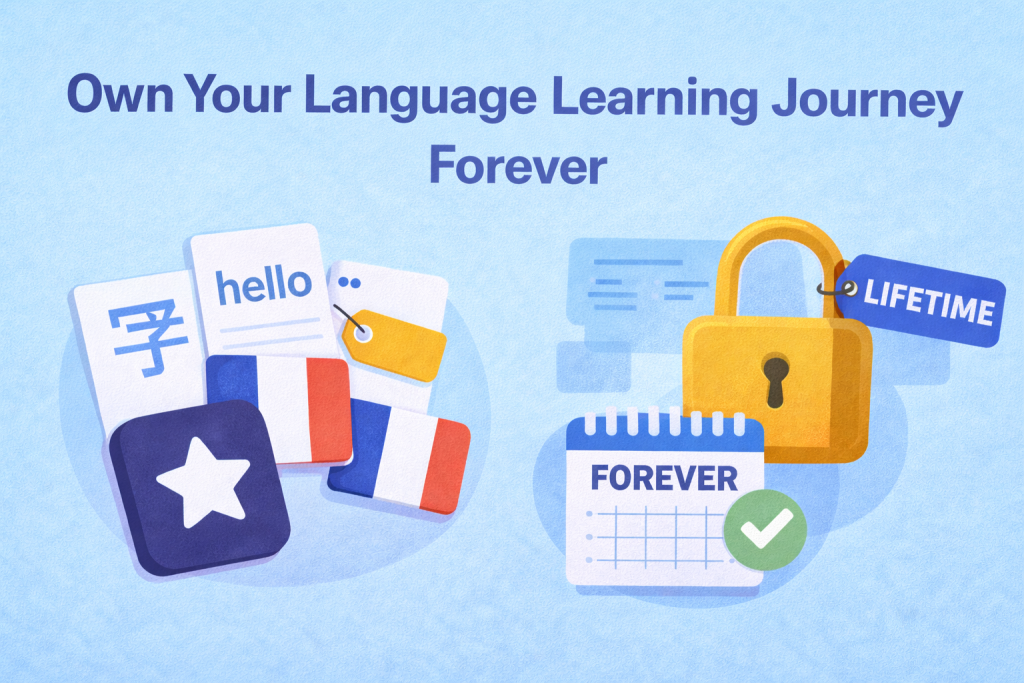
When Hannah, one of our Speakada customers, reached out with a simple question after purchasing her Anki Spanish Flashcards, she touched on something that matters deeply to language learners everywhere: “I was wondering if access to the cards has an end date or is it lifetime access?”
The answer? Yes, absolutely lifetime access.
But Hannah’s question reveals a much bigger issue that affects millions of language learners worldwide. In today’s digital landscape, are you actually building fluency that you own, or are you simply renting access to knowledge that disappears the moment you stop paying?
The Hidden Cost of Subscription-Based Language Learning
Walk into any app store and you’ll find dozens of colorful, gamified language learning platforms. They promise fluency in weeks, celebrate your daily streaks, and send you friendly reminders to practice. What they don’t advertise quite as loudly is what happens when you stop paying the monthly fee.
The moment your subscription ends, everything vanishes. Your carefully accumulated vocabulary lists, your progress tracking, your review schedules, even your motivational streak statistics all become inaccessible. It’s like renting an apartment and being forced to leave all your furniture behind when you move out.
This SaaS (Software as a Service) model has become the dominant force in language education. While these platforms can be engaging and helpful, they create a problematic relationship between learners and their own progress. You’re not building something that belongs to you. You’re paying for temporary access to tools and content that you can never truly own.
The Real Price of “Affordable” Monthly Subscriptions
Let’s talk numbers for a moment. That seemingly modest monthly subscription might look affordable at first glance. But language learning isn’t a sprint; it’s a marathon. True fluency takes years of consistent practice and review.
Consider this: A typical language learning app subscription costs between $10-30 per month. Over the course of three years—a reasonable timeline for reaching intermediate to advanced proficiency—you could easily spend $360 to over $1,000. And if you take a break? You either continue paying to maintain access to your progress, or you lose everything you’ve built.
Even more concerning, if you’re learning multiple languages (perhaps you started with Spanish, added French, and now you’re curious about Italian), those subscription costs multiply quickly. Meanwhile, all that content you’re “accessing” could have been yours permanently for a fraction of the long-term cost.
How Anki and Speakada Offer a Better Path
At Speakada, we built our entire approach around a different philosophy: your learning materials should belong to you, permanently and completely.
Understanding the Anki Foundation
Before diving into what makes Speakada’s approach unique, it’s important to understand Anki itself. Anki is a powerful, open-source flashcard application based on spaced repetition—a scientifically proven method for long-term retention. The software is free for desktop and Android users, with a one-time purchase option for iOS to support the developers who maintain this incredible tool.
What makes Anki remarkable isn’t just that it’s free. It’s that the application and your data live on your devices. Your flashcards, your review history, your statistics—everything is stored locally. You’re not dependent on a company’s servers or subject to their terms of service changes. Learn more about how Anki works and why it’s such an effective tool for language acquisition.
The Speakada Difference: One Payment, Lifetime Ownership
When you purchase our Pronunciation Flashcards, Vocabulary Flashcards, or Grammar Flashcards, you’re making a one-time investment in materials that become yours forever. Here’s exactly what that means:
You own the files. Once you download your decks, they’re yours. They live on your computer, tablet, or phone. No company can revoke your access or change the terms of service.
Your progress is permanent. Take a break for a month? A year? Five years? When you come back, all your cards, statistics, and review schedules are exactly where you left them. Nothing disappears.
No surprise renewals. You’ll never receive an unexpected charge or need to update payment information. One purchase, done.
Free syncing included. Anki offers free cloud syncing across all your devices. Your progress on your laptop automatically updates on your phone, with no subscription required.
Multi-language friendly. Learning multiple languages? Each deck you purchase is a separate, one-time investment. You can work through French vocabulary, German grammar, and Italian pronunciation simultaneously without worrying about escalating monthly costs.
This applies universally across all the languages we support: Spanish, French, Italian, German, English, Dutch, and Polish. Whether you’re exploring Dutch minimal pairs or mastering Polish vocabulary, the principle remains the same—you pay once, you own it forever.
Why Ownership Matters for Long-Term Success
Language learning is inherently unpredictable. Life happens. You might have intense study periods followed by months where you barely open your flashcards. You might focus heavily on Spanish for a year, then shift attention to career development, family commitments, or other priorities.
Traditional subscription models punish this natural rhythm of learning. They force you to choose between continuing to pay for something you’re not actively using or losing all your accumulated progress. This creates unnecessary pressure and anxiety around language learning—the opposite of what you need for long-term success.
The Psychology of Ownership
There’s also a powerful psychological element to ownership. When you truly own your learning materials, you develop a different relationship with them. They’re not borrowed tools you’re renting; they’re investments you’ve made in yourself. This subtle shift can profoundly impact motivation and commitment.
Studies in behavioral psychology consistently show that people value and care for things they own more than things they’re temporarily accessing. Your Anki language learning decks become part of your personal toolkit, available whenever you need them, without guilt or financial pressure.
Building a Sustainable Language Learning Practice
Creating a lasting language learning habit requires removing obstacles and reducing friction. Every barrier between you and your study materials increases the likelihood you’ll procrastinate or quit entirely.
Subscription fatigue is real. In an era where we’re subscribing to streaming services, productivity tools, cloud storage, and countless other monthly payments, adding another recurring charge to your budget can be the straw that breaks the camel’s back. When money gets tight, optional subscriptions are often the first to go—taking your language progress with them.
With a one-time purchase model, your learning materials are always there, always accessible, creating no ongoing financial burden. This freedom allows you to focus on what actually matters: consistent practice and gradual improvement.
Complementary Learning Resources
The lifetime ownership model also gives you flexibility to explore other learning methods without feeling tied to a single platform because “you’re already paying for it.” You can invest in conversation partners, attend language meetups, purchase novels in your target language, or explore immersion experiences, knowing your core study materials are secure and don’t require ongoing funding.
Many successful language learners use Speakada decks as their foundation for vocabulary, pronunciation, and grammar, then supplement with speaking practice, reading, and real-world conversation. This hybrid approach is much easier to maintain when your digital learning tools aren’t demanding monthly payments.

What You Get With Speakada Flashcards
Let’s get concrete about what lifetime ownership looks like with our flashcards:
Comprehensive Language Coverage
Our decks aren’t thrown together quickly. They’re carefully researched, professionally recorded (for pronunciation), and structured to follow proven language learning methodologies. When you purchase a Spanish Grammar Bundle or French Vocabulary Bundle, you’re getting materials designed by experienced language educators.
Professional High Quality Audio
For pronunciation decks across all our languages, we use high quality audios to ensure you’re learning authentic pronunciation from the start. Whether you’re working on English minimal pairs or German IPA, you’ll hear how the language actually sounds like so you can speak confidently.
Structured Learning Paths
Our decks follow the Common European Framework of Reference (CEFR) for language levels. This means our grammar flashcards progress logically from beginner (A0-A2) through intermediate (B1-B2) to advanced (C1) content, giving you a clear roadmap for progression.
Ongoing Updates and Improvements
Even though you pay once, we continue improving our decks. When we enhance a deck you’ve already purchased, you get access to the updated version at no additional cost. This isn’t common in one-time purchase models, but it’s how we believe things should work.
Real Users, Real Results
Hannah isn’t alone in discovering the value of lifetime access. Our customer testimonials consistently mention the relief and empowerment of knowing their learning materials are theirs permanently.
Language learners who’ve bounced between subscription apps often tell us they wish they’d discovered Anki and Speakada earlier. The cumulative cost savings alone can be substantial, but more importantly, they appreciate the psychological freedom of not being on someone else’s payment schedule.
Whether you’re diving deep into Italian common phrases or building a foundation with English alphabet flashcards, you’re investing in tools that will serve you for years or even decades to come.
Making the Switch From Subscription to Ownership
If you’re currently using a subscription-based language learning app, you don’t necessarily need to abandon it immediately. However, it’s worth asking yourself: What happens to all this progress when I eventually stop paying?
Many learners successfully transition by using Speakada and Anki as their core vocabulary and grammar foundation while keeping their subscription app for supplementary gamified practice. Others make a clean break, finding that the depth and flexibility of Anki flashcard learning provides everything they need.
The beauty of the ownership model is that there’s no pressure to decide quickly. You can explore our free resources, try out Anki with free decks, and purchase Speakada materials when you’re ready. They’ll be waiting for you whenever that is.
Your Next Steps in Language Learning
If the idea of truly owning your language learning materials resonates with you, here’s how to get started:
- Download Anki (free for desktop and Android, one-time purchase for iOS)
- Explore our language-specific collections to find the decks that match your current level and goals
- Start with one deck—perhaps a vocabulary bundle or pronunciation guide—and experience the difference
- Build your personal library over time, knowing each purchase is a permanent addition to your learning toolkit
The path to fluency is rarely linear. There will be sprints and pauses, detours and renewed focus. The question is: Will your learning tools support that natural rhythm, or will they punish you for being human?
At Speakada, we believe your progress should be as permanent as your commitment to growth. When you’re ready to dive back in after a break—whether it’s been a week or a year—your flashcards will be right there waiting, no credit card required.
Want more free strategies for smart language learning with Anki flashcards? Subscribe to the SPEAKADA WEEKLY newsletter and get expert tips, learning hacks, and encouragement delivered straight to your inbox. No subscriptions to manage, just helpful insights to support your language journey—because learning should be about progress, not payments.
Subscribe to our newsletter today and join a community of language learners who believe in owning their education.
Make Flashcards Online to Learn Spanish Now One of the biggest challenges when learning Spanish is figuring out how to Read more
Most language learners aim for 10 Anki cards per day — but is that right for you? Discover the 3 Read more
Cloze Deletion Anki Guide - My Experience and What I Use Now In this article, I'm going to be talking Read more
Grammatical Gender and How to Learn Gender Nouns With Anki Recently we were asked a question about the use of Read more