
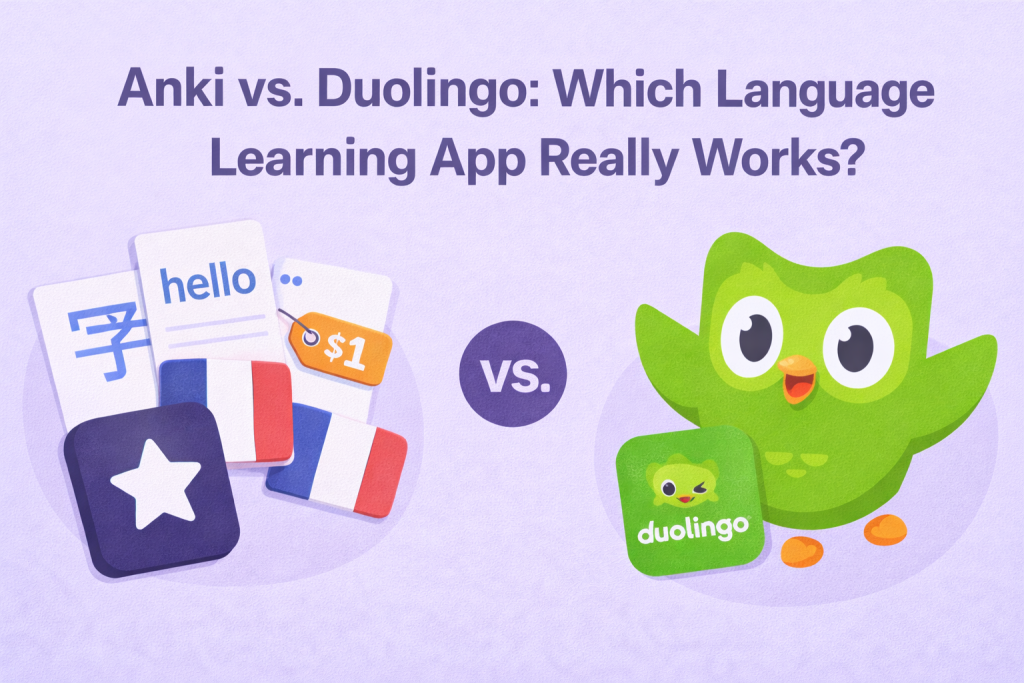
If you’re serious about learning a new language, you’ve probably encountered the age-old debate: Should you use Duolingo or Anki? Both platforms have passionate followers, but they approach language learning in fundamentally different ways. Understanding these differences can save you months of wasted effort and help you reach fluency faster.
Let’s dive deep into this comparison and help you make an informed decision based on your learning goals, time commitment, and how your brain actually retains new information.
Understanding the Two Approaches to Language Learning
Before we compare specific features, it’s important to understand that Duolingo and Anki represent two distinct philosophies in language education. Duolingo gamifies the learning process, making it entertaining and accessible. Anki, on the other hand, leverages cognitive science through spaced repetition to optimize memory retention.
The question isn’t just “which app is better?” but rather “which approach aligns with how you want to learn and what results you’re expecting?”
Duolingo: The Gamified Language Learning Experience
Duolingo has become a household name in language learning, and for good reason. The green owl has convinced millions of people to maintain daily learning streaks, making language practice a habit rather than a chore.
The Strengths of Duolingo
Duolingo excels at lowering the barrier to entry for language learners. It’s completely free to start, requires no setup, and you can begin learning within seconds of downloading the app. The gamification elements—streaks, points, leaderboards, and achievements—tap into our natural desire for completion and competition.
For absolute beginners who have never studied a foreign language, Duolingo provides a gentle introduction. The bite-sized lessons feel manageable, and the colorful interface reduces the intimidation factor that often comes with tackling something as complex as a new language.
The app also covers a wide range of languages, from commonly studied options like Spanish and French to less common choices like Welsh or Hawaiian. This accessibility has democratized language learning in ways that traditional methods never could.
The Limitations of Duolingo
However, Duolingo has significant drawbacks that become apparent once you move beyond the beginner phase. The platform heavily relies on multiple-choice questions and recognition-based exercises rather than active recall. This means you’re often choosing the right answer from a list rather than producing it from memory—a crucial difference in how deeply you learn the material.
The vocabulary selection can sometimes be quirky or impractical. While learning that “the horse eats the apple” might teach you basic sentence structure, it’s not exactly the most useful phrase for real conversations. The curriculum is also linear and one-size-fits-all, which means you can’t customize the pace or focus on areas where you personally need more practice.
Perhaps most critically, Duolingo doesn’t adapt to your individual retention rate. Everyone’s brain forgets at different rates, but Duolingo moves forward according to its predetermined schedule, not based on when you’re actually about to forget the material.
Anki: The Spaced Repetition Powerhouse
While Duolingo feels like playing a game, Anki feels like using a precision tool. It might not be as flashy, but it’s built on decades of cognitive science research into how human memory actually works.
The Science Behind Spaced Repetition
Anki is built on the principle of spaced repetition, a learning technique that presents information at increasing intervals just before you’re likely to forget it. This approach is based on the “spacing effect,” a well-documented phenomenon in cognitive psychology that shows we remember information better when study sessions are spaced out over time rather than crammed together.
When you review Anki Language Learning Flashcards, the algorithm tracks how well you remember each card. Cards you find difficult appear more frequently, while cards you’ve mastered appear less often. This personalized approach means you’re always studying exactly what your brain needs to reinforce, maximizing efficiency and minimizing wasted time.
Active Recall: The Key to Deep Learning
Unlike Duolingo’s multiple-choice format, Anki forces active recall. You see a question or prompt, you must produce the answer from memory, and only then do you flip the card to check if you were correct. This retrieval practice is cognitively demanding, but it’s also incredibly effective at cementing information in long-term memory.
Research consistently shows that active recall produces better learning outcomes than passive review. When you actively retrieve information, you’re strengthening the neural pathways associated with that knowledge, making it easier to access in the future—including in real conversations where you won’t have multiple-choice options.
Customization and Control
Anki gives you complete control over what you learn and when. You can create decks focused on specific vocabulary sets, grammar patterns, or pronunciation challenges. You can adjust the algorithm settings to match your learning pace. You can add images, audio, and even video to your flashcards.
This flexibility is both Anki’s greatest strength and its biggest barrier. While advanced learners and language enthusiasts love this level of control, it can be overwhelming for beginners who just want to start learning without worrying about optimal card formatting or algorithm settings.
The Time Investment Challenge
Here’s where many language learners hit a roadblock with Anki: creating quality flashcards is time-consuming. Each card needs the target language term, the translation, example sentences, pronunciation guides, and ideally high quality audio. For serious learners wanting to master vocabulary flashcards effectively, this can mean hours of preparation before any actual studying begins.
Many learners download pre-made decks from shared collections, but these vary wildly in quality. Some are excellent, while others contain errors, lack audio, or use unnatural example sentences. Sorting through these options and customizing them to your needs becomes another time sink.
This is precisely the problem that prompted the creation of professionally designed Anki decks. Instead of spending hours creating cards or settling for questionable shared decks, learners can access high-quality, expertly crafted flashcard decks that combine Anki’s powerful algorithm with professional content design.
Breaking Down the Comparison: Feature by Feature
Let’s look at how these platforms compare across the factors that matter most for language learning success.
Effectiveness for Vocabulary Acquisition
For building a robust vocabulary quickly, Anki wins decisively. The spaced repetition algorithm ensures that you review words just before forgetting them, leading to stronger long-term retention. Studies have shown that learners using spaced repetition can memorize information 200-300% more efficiently than using conventional study methods.
With professionally designed vocabulary flashcards like Speakada’s, you can master the most frequently used words in your target language in a fraction of the time it would take with Duolingo. For example, learning the top 2000 words in Spanish, French, German, or Italian can give you comprehension of approximately 90% of everyday conversations.
Pronunciation Development
Pronunciation is where both platforms have room for improvement, but structured flashcard systems have an edge when designed correctly. Pronunciation flashcards that include International Phonetic Alphabet (IPA) notation, minimal pairs practice, and high quality audio provide a systematic way to develop accurate pronunciation from the beginning.
Duolingo does include some pronunciation exercises, but they’re often not comprehensive enough to develop truly native-like pronunciation. The app may not consistently correct pronunciation errors, and the exercises appear sporadically rather than as part of a systematic approach.
Grammar Mastery
Grammar is perhaps where the difference between recognition and production becomes most apparent. Duolingo teaches grammar primarily through exposure and pattern recognition within exercises. You might learn to recognize correct grammar usage, but producing it spontaneously in conversation is another matter entirely.
Grammar flashcards designed with clear explanations, example sentences, and progressive difficulty levels allow you to internalize grammar rules through active practice. When you must produce the correct form from memory repeatedly, the pattern becomes automatic in a way that multiple-choice exercises rarely achieve.
Motivation and Consistency
This is Duolingo’s home turf. The app’s streak system, daily reminders, and gamification elements are incredibly effective at building habits. Many learners find themselves opening the app daily just to maintain their streak, even when they’re tired or busy.
Anki requires more self-discipline. The interface is utilitarian, there are no points or achievements, and you must be internally motivated to complete your daily reviews. However, for learners who are motivated by tangible progress and efficiency, seeing yourself master hundreds of words in weeks rather than months can be its own powerful motivator.
Time Efficiency
If you have limited time and want maximum results, Anki’s efficiency is unmatched. A focused 20-minute Anki session, reviewing cards at optimal intervals, will typically result in better retention than an hour of Duolingo exercises that include a lot of repetition of material you’ve already mastered.
The key difference is that Anki adapts to what you know and don’t know, while Duolingo follows a preset curriculum. This means Anki naturally becomes more efficient as you progress, while Duolingo can feel increasingly repetitive.
Cost Considerations
Duolingo is free with ads, or you can pay for Duolingo Plus to remove ads and access offline lessons. Anki is free on desktop and Android, though the iOS app requires a one-time purchase.
However, the real cost consideration is your time. If Duolingo takes you twice as long to reach the same level of fluency (or if it never quite gets you there), that’s a hidden cost that dwarfs any subscription fees.

The Hybrid Approach: Can You Use Both?
Some learners wonder if they should use both platforms together. While this is possible, it often leads to burnout or one platform being neglected. The methods are different enough that splitting your focus may reduce overall effectiveness.
A more strategic approach is to use the right tool for your current stage and goals. If you’re exploring whether you even enjoy learning a language, Duolingo’s fun approach might help you test the waters. But once you’re committed to reaching fluency, transitioning to a more efficient method like spaced repetition will accelerate your progress dramatically.
Making Your Decision: Which Platform Is Right for You?
The choice between Anki and Duolingo ultimately depends on your goals, timeline, and learning preferences.
Choose Duolingo if:
- You’re a complete beginner testing the waters
- You need gamification to stay motivated
- You’re learning casually without a specific deadline
- You want a fully guided experience with no setup required
- You’re learning a language that Anki doesn’t have good resources for
Choose Anki if:
- You’re serious about reaching conversational fluency or beyond
- You want the most time-efficient learning method
- You’re willing to be more self-directed in your learning
- You have specific vocabulary or grammar goals
- You want to ensure long-term retention of what you learn
Choose Professional Anki Decks if:
- You want Anki’s efficiency without the setup time
- You value high-quality audio in your target language
- You want scientifically structured vocabulary progression
- You need professionally designed pronunciation and grammar materials
- You’re ready to accelerate your learning without spending hours creating flashcards
How Professional Flashcard Decks Solve Anki’s Biggest Problem
The most common complaint about Anki is that creating quality flashcards is tedious and time-consuming. You need to find reliable sources, record or download audio, format cards correctly, and organize everything into a logical progression. For many learners, this prep work alone is enough to make them give up before they even start studying.
This is where professionally designed flashcard collections transform the Anki experience. Instead of spending hours on card creation, you can immediately begin studying with decks that include high quality audio, IPA pronunciation guides, contextual example sentences, and scientifically sequenced vocabulary.
Whether you’re learning Spanish, French, German, Italian, Dutch, Polish, or English, you can access comprehensive decks that combine the power of spaced repetition with professional language education expertise.
Real-World Success: What Actually Works
Talk to polyglots and language learning enthusiasts who have reached genuine fluency in multiple languages, and you’ll find that the vast majority eventually moved beyond gamified apps to more intensive methods. Many specifically credit spaced repetition systems for helping them reach advanced levels.
This doesn’t mean Duolingo has no value—it has helped millions of people take their first steps in language learning. But for learners who want to move beyond basic phrases and actually use their target language in real conversations, more intensive methods become necessary.
The learners who progress fastest are those who understand how Anki works and leverage it effectively from the early stages of their learning journey.
Beyond the Apps: Building a Complete Learning System
Neither Anki nor Duolingo should be your only language learning tool. The most successful learners build a comprehensive system that includes spaced repetition for vocabulary and grammar, immersion through reading and listening, active speaking practice, and real conversations with native speakers.
Anki serves as the foundation—the efficient way to build your vocabulary and internalize grammar patterns. But you should supplement it with reading books, watching shows, listening to podcasts, and most importantly, speaking with real people in your target language.
For speaking practice specifically, you might explore speaking fluency practice techniques and speaking templates that help you move from vocabulary knowledge to actual conversation skills.
Taking Your Learning Further
If you’re ready to experience the difference that spaced repetition can make in your language learning journey, starting with professionally designed flashcard decks removes the biggest barrier: time-consuming card creation.
Explore comprehensive collections for your target language, including specialized decks for pronunciation, high-frequency vocabulary, and grammar at every level from beginner to advanced. Whether you need Spanish pronunciation, French grammar, German vocabulary, or any other specific focus area, professionally designed decks let you jump straight into effective studying.
Stay Connected: Join Our Learning Community
Want to continue improving your language learning strategy? Subscribe to the SPEAKADA WEEKLY newsletter to receive expert tips, evidence-based learning strategies, and practical advice delivered directly to your inbox. Each week, you’ll discover new ways to accelerate your progress with Anki flashcards and proven language learning techniques. Join thousands of smart language learners who are reaching fluency faster with our free weekly insights.
Sign up for the newsletter here and take your language learning to the next level.
The Bottom Line
When choosing between Anki and Duolingo, ask yourself: Do you want to play a language learning game, or do you want to efficiently hack your memory and reach fluency as quickly as possible?
Duolingo has its place as a fun introduction to language learning, but serious learners who want measurable results consistently turn to spaced repetition systems. And with professionally designed Anki decks, you get the efficiency of spaced repetition without the headache of creating cards yourself.
The question isn’t whether spaced repetition works—the science is clear that it does. The question is whether you’re ready to commit to a learning method that respects your time and your brain’s natural learning processes. If you are, explore our professionally designed Anki language learning flashcards and discover how much faster you can progress when you’re using the right tool for the job.
Your future fluent self will thank you for making the smart choice today.
Make Flashcards Online to Learn Spanish Now One of the biggest challenges when learning Spanish is figuring out how to Read more
Most language learners aim for 10 Anki cards per day — but is that right for you? Discover the 3 Read more
Cloze Deletion Anki Guide - My Experience and What I Use Now In this article, I'm going to be talking Read more
Grammatical Gender and How to Learn Gender Nouns With Anki Recently we were asked a question about the use of Read more