
If you’ve been learning a language with Anki flashcards, you’ve probably experienced that frustrating moment: you can handle conversations about travel, order food at restaurants, and ask for directions with confidence. But when native speakers talk naturally—at their actual speed—you suddenly feel lost. You catch a word here and there, but the flow of the conversation escapes you.
You’re not alone. This is one of the most common language learning plateaus learners face, and it has a solution rooted in linguistics research.
The Language Learning Gap: Why Phrases Alone Aren’t Enough
Anki flashcards have become incredibly popular for language learning, and for good reason. They use spaced repetition and active recall—two of the most scientifically-backed methods for retaining information. When you combine Anki with well-designed vocabulary and phrase decks, you create a powerful learning system.
But here’s what many learners discover: common phrases flashcards alone, while valuable for building conversational confidence, don’t give you the complete vocabulary foundation needed to understand native speakers in real contexts.
Think of it this way: phrases are your conversational shortcuts. They get you through immediate situations. But they’re not the same as having a comprehensive vocabulary foundation.
This is where most self-guided language learning strategies fall short.
Understanding the Research: The 2000-Word Threshold
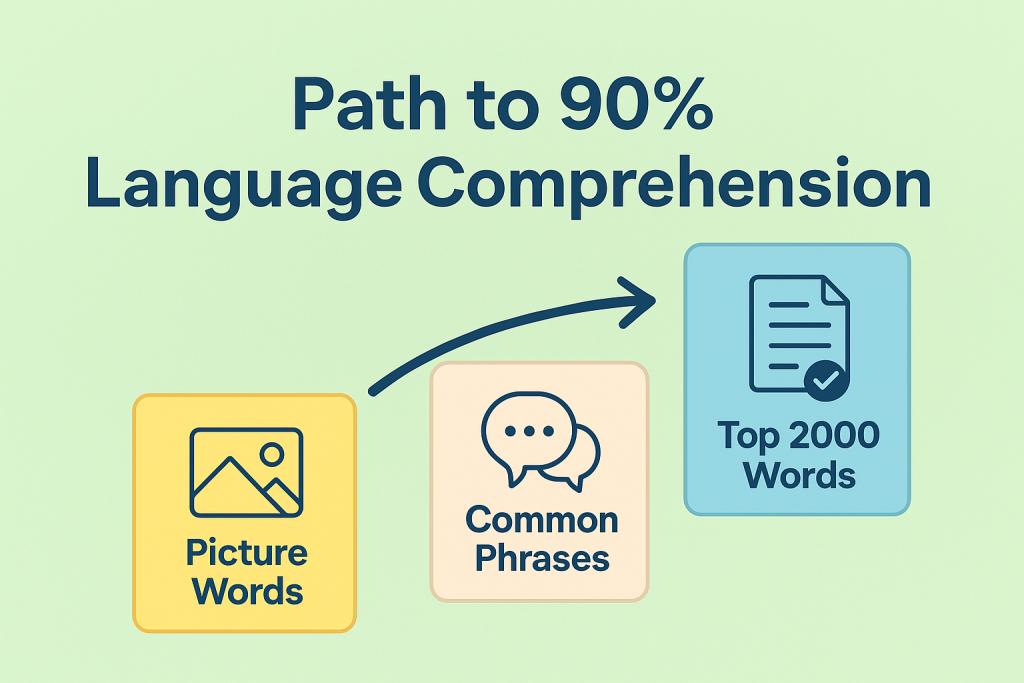
Linguist Paul Nation conducted groundbreaking research that revealed something remarkable: learning the 2000 most frequent word families in a language gives you approximately 90% comprehension of native language materials. Not “pretty good comprehension.” Not “decent understanding.” We’re talking about understanding roughly 9 out of every 10 words in authentic Spanish books, French podcasts, German movies, or Italian conversations.
This isn’t theoretical—it’s been validated across multiple languages and learning contexts. The research shows that those 2000 words aren’t random selections. They represent the most frequent words that native speakers actually use in everyday communication, over and over again.
When you strategically learn these 2000 most common words using Anki’s spaced repetition system, you’re not wasting time on obscure vocabulary that rarely appears in real conversations. You’re building the exact foundation that matters for genuine comprehension.
For learners using Anki for Spanish, French, German, Italian, Dutch, Polish, or English, this research-backed approach transforms how quickly they reach functional comprehension.
The Progression That Actually Works: A Structured Vocabulary Path
So if phrases alone aren’t enough, and 2000 words is the magic number, what’s the right progression for language learners?
Research and real-world success stories from language learners reveal a clear pattern that works:
Step One: Picture Words (500 Most Visual Words)
You start by learning 500 of the most frequently occurring words that have strong visual associations. This builds visual memory anchors that help information stick. Using images with these words—a proven technique backed by MIT research on memory encoding—you create multiple neural pathways for recall. These foundational words appear constantly in everyday communication and media.
When you use vocabulary flashcards with pictures, you’re leveraging how human memory actually works. Your brain is naturally wired to remember images more effectively than abstract information. This is why Anki vocabulary decks that incorporate visual elements produce faster results than text-only approaches.
Step Two: Common Phrases (100+ Practical Phrases)
Once you’ve built this visual foundation, you layer in practical phrases. These aren’t random—they’re the conversational shortcuts you actually need for travel, social situations, and everyday interactions. Common phrases flashcards give you immediate confidence and teach you how to use those picture words in real context.
Learners often report that this is where they experience their first breakthrough moment. Suddenly, they’re thinking in their target language instead of constantly translating in their head. That mental shift is powerful and motivating.
Step Three: Top 2000 Words (The Comprehension Threshold)
Finally—and this is crucial—you expand to the top 2000 most frequent words. These top 2000 words flashcards include not just isolated vocabulary but real sentences and monolingual definitions in your target language. This isn’t busywork; it’s the systematic building of the vocabulary foundation that research shows leads to 90% comprehension.
This is where the transformation happens. Suddenly, you’re not just surviving conversations with native speakers—you’re actually understanding them. You can watch Spanish content, listen to French podcasts, read Italian books, or follow German conversations without constantly stopping to look up words.
One learner described it perfectly: “After the Picture Words and Phrases, I thought I was done. Then I tried the Top 2000 Words, and suddenly I could watch Spanish content and actually follow along. Game changer.”
How These Three Elements Work Together
The reason this progression is so powerful is that each component builds on the previous one. You’re not starting from scratch at each stage. You’re expanding systematically.
When you have the complete vocabulary foundation—picture words plus practical phrases plus the top 2000 words—working together through Anki flashcard decks, something remarkable happens. The research and anecdotal evidence align: you reach that 90% comprehension threshold where language learning shifts from frustrating to fun.
The key is that all three are scientifically structured. They’re built on the same word frequency research. They’re designed to work together in Anki, taking full advantage of spaced repetition and active recall. And crucially, they use proven memory techniques—visual associations, real-world context, and progressive complexity.
This is why comprehensive Anki vocabulary bundles that include all three components consistently outperform piecemeal approaches where learners buy individual decks without understanding how they fit together.
Beyond Vocabulary: The Complete Language Learning System
While vocabulary is foundational, comprehensive language learning means addressing other key areas too. Many successful learners combine Anki vocabulary flashcards with complementary resources.
Pronunciation flashcards, for instance, help you master the sounds of your target language from the beginning. When you learn pronunciation correctly upfront—using IPA guides and minimal pairs—you internalize proper accent and phonetic patterns. This prevents fossilized mispronunciations that become harder to correct later.
Similarly, grammar flashcards structured by proficiency level (beginner A0-A2, intermediate B1-B2, and advanced C1) ensure you’re building grammatical understanding systematically alongside your vocabulary growth. Grammar and vocabulary develop together most effectively.
Whether you’re focusing on Spanish Anki decks, French Anki decks, German flashcards, Italian flashcards, Dutch vocabulary, Polish language learning, or English pronunciation, the principle remains the same: systematic, interconnected learning produces better results than random resource collection.
Real Results: What Learners Achieve
The transformation happens when learners commit to the full progression. Here’s what becomes possible:
You move from tourist-level interactions to genuine understanding. You stop being someone with a phrasebook; you become someone who actually comprehends. You can watch native content—Spanish films, French news, German podcasts, Italian cooking shows—without constant pausing and dictionary lookups. You have real conversations where you understand not just individual words but context, nuance, and humor.
This isn’t fluency yet—but it’s something more important. It’s the threshold where language learning stops being frustrating struggle and becomes genuinely enjoyable. Once you understand what native speakers are actually saying, motivation naturally increases, and continued learning accelerates.
Making the Right Choice for Your Learning Path
If you’ve been using Anki for language learning but feeling stuck at the conversational-but-not-comprehensive level, the answer isn’t working harder—it’s working smarter. It’s understanding that phrases plus picture words plus the top 2000 words, systematically combined, creates the vocabulary foundation that research proves leads to real comprehension.
When you’re learning a language with Anki, one of the biggest advantages is having access to pre-made, research-backed decks. You don’t have to figure out which 2000 words matter most, create your own example sentences, or guess at the optimal learning sequence. That work is done for you, leaving you to focus on the actual learning.
The vocabulary bundle approach—combining picture words, common phrases, and top 2000 words—is how successful language learners move past the plateau. It’s how they go from “I can order coffee” to “I can watch a movie and understand it.”
Your Next Step: Building the Foundation That Transforms Learning
Language learning is a journey, and it’s important to enjoy the process while making genuine progress. The research is clear: learning the 2000 most frequent words gives you 90% comprehension. The progression from visual words to phrases to comprehensive vocabulary is proven effective. The tools—Anki flashcards with spaced repetition—work.
The question isn’t whether this approach works. The question is whether you’re ready to take it.
If you’ve been thinking about moving beyond basic conversational ability, if you want to understand native content and truly comprehend your target language, now is the moment to build that foundation properly. Start with Anki language learning flashcards structured around scientific research and designed to work together.
Your next level of comprehension is waiting. The path is clear. The research supports it. All that’s left is taking the first step.
Subscribe for More Smart Language Learning Strategies
Want to discover more proven techniques for accelerating your language learning with Anki? Real language learners share their breakthroughs, research-backed strategies, and insider tips for moving from basic communication to genuine comprehension.
Subscribe to the Speakada Weekly Newsletter and get weekly insights on maximizing your Anki flashcard learning, vocabulary progression strategies, and language learning science delivered to your inbox. Join hundreds of language learners who are achieving their comprehension goals faster with smart, systematic approaches to language learning.
Subscribe now to get exclusive tips, special promotions, and the latest research on language learning efficiency—all designed to help you reach that 90% comprehension threshold and beyond.
Recommended Flashcard Resources by Language
Ready to build your vocabulary foundation? Start with the research-backed progression:
Spanish Learners: Spanish Vocabulary Bundle | Spanish Picture Words | Spanish Top 2000 Words
French Learners: French Vocabulary Bundle | French Picture Words | French Top 2000 Words
German Learners: German Vocabulary Bundle | German Picture Words | German Top 2000 Words
Italian Learners: Italian Vocabulary Bundle | Italian Picture Words | Italian Top 2000 Words
Dutch Learners: Dutch Vocabulary Bundle | Dutch Picture Words | Dutch Top 2000 Words
Polish Learners: Polish Vocabulary Bundle | Polish Picture Words | Polish Top 2000 Words
English Learners: English Vocabulary Bundle | English Picture Words | English Top 2000 Words
Make Flashcards Online to Learn Spanish Now One of the biggest challenges when learning Spanish is figuring out how to Read more
Most language learners aim for 10 Anki cards per day — but is that right for you? Discover the 3 Read more
Cloze Deletion Anki Guide - My Experience and What I Use Now In this article, I'm going to be talking Read more
Grammatical Gender and How to Learn Gender Nouns With Anki Recently we were asked a question about the use of Read more