
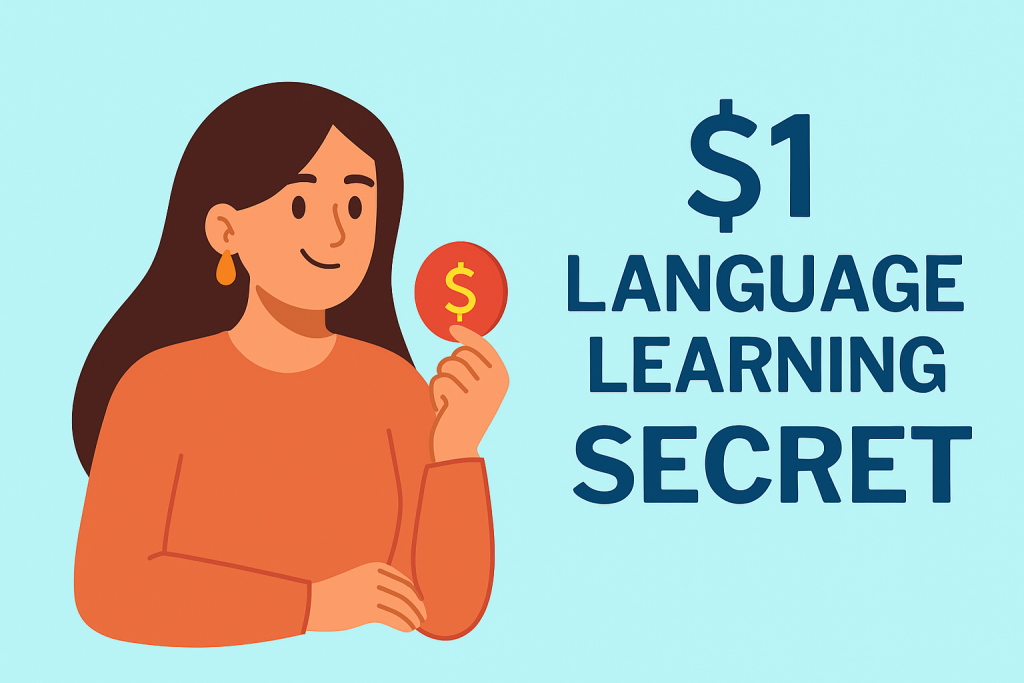
When Marienta first discovered Speakada’s approach to language learning, she was captivated. The philosophy made sense. The flashcards looked promising. But like many language learners standing at the starting line, she hesitated. The investment felt uncertain. Would Anki really work for her? Would the time commitment pay off?
Then something changed everything—a single dollar.
This is the story of how small beginnings lead to genuine fluency, and why the biggest barrier to language learning might not be what you think it is.
The Language Learning Paradox: Why You Already Know You Need This
You’ve probably experienced this feeling before. You want to become fluent in a new language. You’ve read articles about effective learning methods. You’ve researched the best tools for language acquisition. You might have even told your friends about that promising approach you found online—much like Marienta did with Speakada.
But taking that first step? That’s where the friction happens.
The traditional narrative of language learning suggests you need months of commitment, hundreds of dollars invested upfront, and the mental energy to wonder if you’re making the right choice. This is precisely why so many language learners never begin, or begin and quit within weeks.
Here’s what the research shows: the most successful language learners aren’t necessarily the most talented or the wealthiest. They’re the ones who remove barriers to getting started.
Meeting Learners Where They Are: The Anki Advantage
Anki language learning flashcards have revolutionized how people approach vocabulary acquisition and language retention. Unlike traditional textbooks or generic flashcard apps, Anki uses scientifically-proven spaced repetition—a learning technique that fights against the natural human tendency to forget.
But here’s the challenge: while Anki itself is free, having high-quality, professionally-designed flashcards specifically created for language learning makes all the difference. This is where many learners get stuck. They download Anki, stare at the blank interface, and think: “Now what?”
When Marienta encountered Speakada’s flashcards, she immediately grasped the value. The comprehensive approach resonated with her. She even shared the opportunity with her friends. Yet she still hadn’t taken action—not because the value wasn’t clear, but because the commitment threshold felt too high.
This is where the $1 entry point changes everything.
Why $1? The Psychology of Low-Barrier Learning
Let’s be honest: $1 is not about price. It’s about removing objections.
When you invest just one dollar in Top 100 Words Flashcards, you’re not making a major financial decision. You’re not gambling on whether Anki will work for you. You’re testing a hypothesis with virtually zero risk.
Consider what $1 is less than:
- A cup of coffee at your local café
- A bottle of water at an airport
- A candy bar at the checkout counter
- That subscription app you downloaded once and never used again
- A single lunch
Yet what you get for that $1 is transformative.
You get access to 100 carefully curated words in your target language. These aren’t random vocabulary items—they’re the most essential, highest-frequency words that form the foundation of everyday conversation. Linguistic research consistently shows that knowing just 100 words gives you comprehension of approximately 50% of everyday spoken language in any tongue.
Think about that. Fifty percent comprehension from one hundred words, available for the price of a piece of gum.
What’s Inside: The Anatomy of Speakada’s Top 100 Words Flashcards
When you purchase your Top 100 Words Flashcards for $1, you’re not getting a basic list of translations. You’re getting professionally-designed Anki flashcards that include:
Two randomized question formats to keep your brain engaged and prevent memorization tricks. You’ll see both “Word Comprehension” cards that test your recognition and “Sentence Comprehension” cards that place words in context.
Grammatical gender indicators using color-coding, a feature that’s essential if you’re learning a gendered language like Spanish, French, German, or Italian. This means you learn not just what the word means, but how to use it correctly.
Part of speech tags so you understand whether you’re learning a noun, verb, adjective, or other linguistic category. This context dramatically improves retention and application.
IPA pronunciation guides using the International Phonetic Alphabet, allowing you to perfect your pronunciation from day one. This is crucial for learners who want to develop native-like speech patterns.
Audio pronunciation recordings featuring native speakers, so you’re not just reading—you’re listening and learning the authentic sounds of the language.
Frequency rankings showing how common each word is, helping you understand why these particular 100 words matter most. This motivates learning because you see immediate real-world application.
Monolingual definitions in your target language, pushing your brain to think in the language rather than translating back to English. This accelerates the transition to genuine fluency.
Example sentences demonstrating each word in authentic context, showing you how native speakers actually use these words in real conversations.
This comprehensive approach is why Speakada’s vocabulary flashcards have become trusted resources for language learners across all proficiency levels.
Beyond $1: The Complete Speakada Ecosystem
What makes the $1 entry point so powerful is what comes after.
Once you experience how naturally these words stick using spaced repetition, once you catch yourself using them in actual conversations, once you feel that momentum building—that’s when the bigger picture clicks into focus.
Speakada offers a complete progression pathway for serious language learners:
Pronunciation Flashcards for mastering the sounds of your target language through alphabet cards, IPA training, and minimal pairs work. Proper pronunciation isn’t just about sounding good—it’s about being understood and building confidence in conversations.
Vocabulary Flashcards that go far beyond the Top 100, including 500 picture words for visual learners, comprehensive top 2000 words lists, and common phrases that keep language practical and conversational.
Grammar Flashcards structured according to CEFR proficiency levels—from A0 beginner through C1 advanced. This means you can progress systematically, ensuring you’re always learning grammar appropriate to your current level.
Whether you’re interested in Spanish Anki flashcards, French learning decks, German flashcards, Italian cards, Dutch flashcards, Polish decks, or English flashcards, the same quality and pedagogical rigor applies.
The Real Cost of Language Learning: Time vs. Method
Here’s something most language learning companies won’t tell you: your time is more valuable than your money.
When you learn with the wrong method, you waste months. When you use ineffective flashcards, you forget words you spent hours studying. When you guess at pronunciation, you cement bad habits that take years to correct.
The $1 Top 100 Words Flashcards aren’t just affordable—they’re efficient. By using Anki’s spaced repetition system, you’re leveraging neuroscience-backed learning principles. Your brain is wired to forget information systematically, and spaced repetition works with that natural process rather than against it.
This is why Speakada’s approach to learning with Anki consistently delivers results. Users like Marienta aren’t just accumulating vocabulary—they’re building the genuine conversational confidence that comes from efficient, effective learning.
The Objection Solver: What’s Really Holding You Back?
Let’s address this directly. If you’re reading this and still hesitating, ask yourself which of these is the real barrier:
“It’s too expensive.” The Top 100 Words Flashcards are $1. This isn’t an expense—it’s barely worth mentioning. If budget were truly the barrier, you’d already be learning with free resources. The real barrier is something else.
“I’m not sure Anki will work for me.” Understandable. But for $1, you can find out instead of wondering forever. Thousands of language learners have confirmed that spaced repetition works. Why should you be different? The only way to know for certain is to try it.
“I don’t want to commit to something I might not stick with.” This is honest, and it’s common. But the Top 100 Words Flashcards are the low-commitment entry point. You’re not signing up for a year-long program. You’re spending five minutes a day for a few weeks. If it’s not working after two weeks, you’ve lost a dollar and gained clarity. That’s a good trade.
“I’m worried I’ll waste time.” Here’s the thing: you’re spending time on language learning regardless. The question isn’t whether you’ll invest time—it’s whether that time will be wasted or well-spent. Speakada’s flashcards ensure your time compounds into real progress.
“I don’t know if I’ll actually use them.” Fair point. But consider: you’re already here, reading this article about language learning. You clearly care about improving. You’ve already told people about learning languages. You’re already interested. So the question becomes: would $1 and five minutes a day be enough to prove to yourself that this works?
The Domino Effect: How One Small Step Changes Everything
When Marienta decided to engage with Speakada, something happened that the company probably didn’t expect: she shared it with her friends.
This is the domino effect of effective language learning tools. When something actually works, people naturally talk about it. They recommend it. They share it.
But here’s what’s interesting: Marienta had shared Speakada with friends before even purchasing anything. She recognized the value in the philosophy and the approach. What was missing wasn’t belief in the method—it was permission to start small.
The $1 entry point provides exactly that permission.
Once you start with the Top 100 Words Flashcards and experience:
- Words that stick in your memory naturally
- Pronunciation that becomes automatic through repetition
- Confidence building with each card you master
- Momentum that makes you want to continue
…then the path forward becomes obvious. You naturally progress to vocabulary bundles, then explore grammar at your proficiency level, then perhaps dive into specialized learning like common phrases.
This isn’t upselling. This is the natural progression of a learner who’s found something that works.
Making It Real: Your First Step to Fluency
Language fluency isn’t mystical. It doesn’t require special talent or “language learning genes.” It requires three things:
- The right learning method — Spaced repetition through flashcards has decades of research supporting its effectiveness
- Quality content — Professional Anki decks designed by language learning experts, not random crowdsourced material
- Low friction to start — A barrier small enough that you actually begin, rather than endlessly contemplating
Speakada’s $1 Top 100 Words Flashcards provide all three.
You already know you want to improve your language skills. You’re already here. You’ve already shown interest. You might have already mentioned this to friends.
So here’s the real question: What’s the smallest possible step forward you could take today?
It’s not months of study. It’s not hundreds of dollars. It’s not an overwhelming commitment.
It’s $1 and five minutes a day.
This is how you go from being someone interested in language learning to being someone who’s actually learning. This is how you build the momentum that leads to genuine fluency. This is how you become someone who can have real conversations in your target language—the way Marienta can now engage in Spanish with Matthew Alberto.
Ready to Begin? Your Language Learning Journey Starts Here
The Top 100 Words Flashcards are available for Spanish, French, Italian, German, Dutch, Polish, American English, and British English.
Get your Top 100 Words Flashcards here for just $1
And once you’ve experienced how Speakada’s approach works, you’ll have access to the complete ecosystem: pronunciation training, comprehensive vocabulary building, and systematic grammar mastery.
But first: take that $1 step. Try the 100 words. Experience spaced repetition. Feel the momentum building.
That’s how fluency begins.
Want to Take Your Language Learning Even Further?
If you’re serious about reaching fluency faster and unlocking proven language learning strategies with Anki flashcards, I encourage you to subscribe to the Speakada Weekly newsletter.
Our newsletter delivers free tips, insider insights, and smart learning strategies directly to your inbox. You’ll discover how to maximize your Anki practice, learn pronunciation techniques used by fluent speakers, and get exclusive access to special offers on vocabulary and grammar flashcards.
Join hundreds of language learners who are already getting weekly inspiration and practical guidance to accelerate their journey to fluency. Sign up for the Speakada Weekly newsletter today and get started on your path to speaking with genuine confidence.
Your next breakthrough is just an email away.
Speakada specializes in Anki language learning flashcards for Spanish, French, Italian, German, Dutch, Polish, and English. All flashcards are professionally designed with pronunciation guides, native audio, and comprehensive explanations to help you learn faster and retain longer.
Make Flashcards Online to Learn Spanish Now One of the biggest challenges when learning Spanish is figuring out how to Read more
Most language learners aim for 10 Anki cards per day — but is that right for you? Discover the 3 Read more
Cloze Deletion Anki Guide - My Experience and What I Use Now In this article, I'm going to be talking Read more
Grammatical Gender and How to Learn Gender Nouns With Anki Recently we were asked a question about the use of Read more