
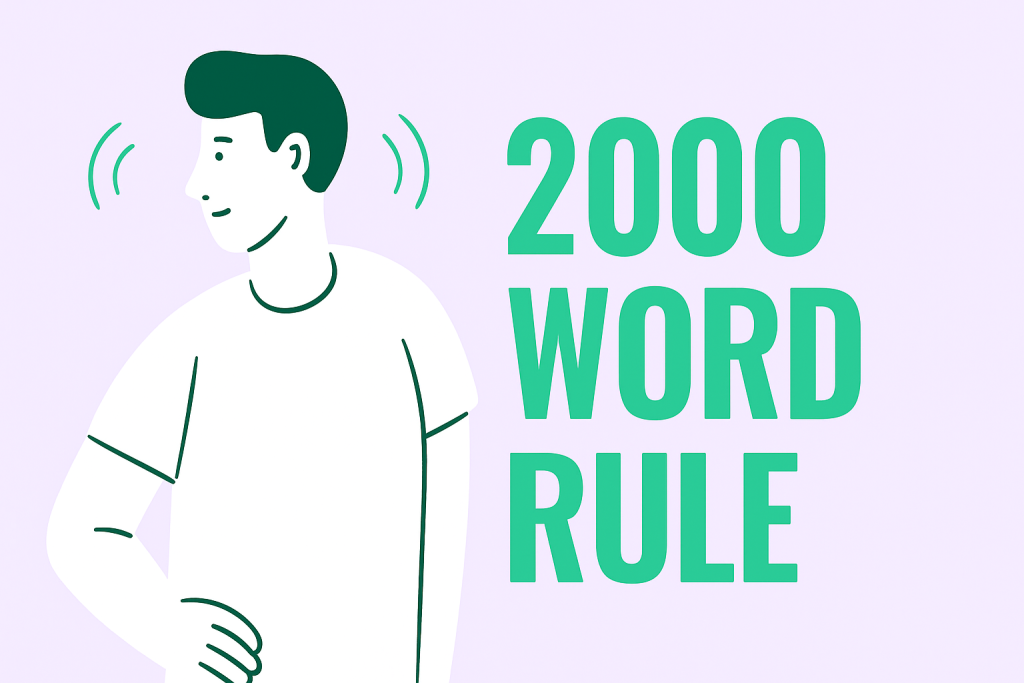
Learning a new language can feel overwhelming. With hundreds of thousands of words in most languages, where do you even begin? Here’s a game-changing revelation that will transform your approach to language learning: you only need about 2,000 high-frequency words to understand 90% of most native language materials.
This isn’t just a catchy claim—it’s backed by solid linguistic research that has revolutionized how we think about vocabulary acquisition. Let’s explore why this approach works and how you can use it to accelerate your language learning journey.
The Science Behind High-Frequency Word Learning
Understanding Word Frequency Distribution
Not all words are created equal. Language follows a predictable pattern known as Zipf’s law, where certain words appear far more frequently than others. Research by renowned linguist Paul Nation reveals that approximately 2,000 word families fall into the high-frequency category, offering substantial coverage of nearly 90% of most native language materials.
This discovery has profound implications for language learners. Instead of attempting to memorize every word in a dictionary—which could contain 400,000 to 600,000 entries—you can achieve remarkable comprehension by strategically focusing on the most commonly used words.
Research-Based Evidence
Multiple studies support the effectiveness of frequency-based vocabulary learning:
- Classroom Learning Limitations: Studies across language classrooms in Japan, Indonesia, Israel, and Spain show that learners typically grasp only 2-3 words per hour of traditional classroom instruction.
- Reading Alone Isn’t Enough: Professor Cobb from The Université du Québec à Montréal found that relying solely on extensive reading doesn’t provide sufficient exposure to useful vocabulary for consistent learning.
- Native Speaker Vocabulary: Research from Ghent University shows that first-year university students (native English speakers) know approximately 9,800 words, while other studies suggest educated adults command vocabularies of 10,000 to 20,000 word families.
Why Traditional Language Learning Methods Fall Short
The Dictionary Trap
Many language learners fall into the “dictionary trap”—believing they need to learn every possible word. Consider these statistics:
- Oxford English Dictionary: Over 600,000 words
- Merriam-Webster Dictionary: Over 400,000 words
Learning every word would require mastering 1,643 words daily for an entire year—an impossible task that would take over 166 years at a reasonable pace of 10 words per day.
Classroom and Reading Limitations
Traditional methods often fail because they:
- Don’t prioritize word frequency
- Provide insufficient repetition for long-term retention
- Lack systematic organization of vocabulary learning
- Focus on breadth rather than depth of essential vocabulary
The Power of Strategic Vocabulary Learning
Focus on What Matters Most
The beauty of the 2,000 word approach lies in its efficiency. By concentrating on high-frequency vocabulary, you gain:
- Maximum Coverage: Understanding 90% of conversations, books, and media
- Quick Progress: Noticeable improvement in comprehension within weeks
- Motivation Boost: Seeing rapid results encourages continued learning
- Solid Foundation: A strong base for acquiring additional vocabulary naturally
Word Families vs. Individual Words
It’s important to understand that these 2,000 “words” actually refer to word families or lemmas. A word family includes the root word plus all its related forms. For example:
- “Friend” family: friend, friendly, friendship, friends, unfriendly
- “Photo” family: photo, photograph, photography, photogenic, photocopy
- “Sun” family: sun, sunny, sunshine, sunlight, sunbathe, sunburn
This approach significantly multiplies your vocabulary knowledge while maintaining focus on essential concepts.
Implementing High-Frequency Vocabulary Learning
The Anki Advantage
Digital flashcards, particularly those using Anki’s spaced repetition system (SRS), provide the optimal method for mastering high-frequency vocabulary. Here’s why:
- Spaced Repetition: Reviews cards at scientifically optimized intervals
- Active Recall: Forces your brain to retrieve information, strengthening memory
- Progress Tracking: Monitors your learning and adjusts difficulty accordingly
- Portability: Study anywhere, anytime on your mobile device
- Efficiency: Focuses review time on words you find challenging
Creating an Effective Learning Schedule
Learning 2,000 words becomes manageable with proper planning:
- Daily Goal: 10-15 new words per day
- Monthly Progress: Approximately 300-450 words
- Timeline: Complete the core 2,000 words in 4-7 months
- Review Time: 15-30 minutes daily for maximum retention
Beyond the First 2,000 Words
Building Advanced Vocabulary
Once you’ve mastered the high-frequency core, you can expand strategically:
- Mid-Frequency Words: The next 3,000-5,000 most common words
- Domain-Specific Vocabulary: Words relevant to your interests or profession
- Cultural and Contextual Terms: Expressions and idioms for natural communication
Maintaining Long-Term Retention
The spaced repetition system ensures that once learned, vocabulary stays learned. Regular review sessions become shorter and less frequent as words move into your long-term memory.
Success Stories and Real-World Applications
Measurable Progress
Students using frequency-based vocabulary learning report:
- Improved reading comprehension within weeks
- Enhanced listening skills in movies and conversations
- Increased confidence in speaking
- Reduced translation dependency
Language-Specific Benefits
This approach works across all languages, whether you’re learning:
- Spanish: Understanding telenovelas and news broadcasts
- French: Navigating French literature and media
- German: Comprehending complex grammatical structures in context
- Italian: Enjoying authentic Italian films and conversations
- English: Mastering academic and professional communication
Maximizing Your Language Learning Efficiency
Smart Study Strategies
To get the most from high-frequency vocabulary learning:
- Use Visual Associations: Connect words to images for better retention
- Practice in Context: See words in sentences, not isolation
- Audio Integration: Include pronunciation practice with every word
- Regular Testing: Use recall exercises to strengthen memory pathways
- Consistent Schedule: Daily practice trumps occasional marathon sessions
Technology Integration
Modern language learning leverages technology for maximum efficiency:
- Mobile apps for on-the-go studying
- Synchronized progress across devices
- Audio pronunciation guides
- Progress analytics and achievement tracking
Getting Started with High-Frequency Vocabulary
Choosing the Right Resources
When selecting vocabulary materials, prioritize:
- Research-based word lists compiled by linguists
- Frequency rankings based on large language corpora
- Spaced repetition systems for optimal review timing
- Multi-modal learning combining text, audio, and images
Want to supercharge your language learning journey? Subscribe to the SPEAKADA WEEKLY newsletter for exclusive tips, strategies, and insights on smart language learning with Anki flashcards. Get access to expert advice, success stories, and the latest research in efficient language acquisition—delivered straight to your inbox every week.
Building Your Learning Routine
Success with high-frequency vocabulary requires consistency:
- Morning Sessions: Start your day with 10-15 minutes of new vocabulary
- Review Breaks: Use spare moments throughout the day for quick reviews
- Evening Consolidation: End your day reinforcing what you’ve learned
- Weekly Assessment: Track progress and adjust your learning plan
The Long-Term Benefits of Strategic Vocabulary Learning
Academic and Professional Advantages
Mastering high-frequency vocabulary provides:
- Enhanced reading speed and comprehension
- Improved writing clarity and precision
- Better performance on language proficiency tests
- Increased confidence in academic and professional settings
Cultural Connection
Understanding the most common words helps you:
- Appreciate literature and media in the original language
- Engage in meaningful conversations with native speakers
- Understand cultural nuances and context
- Feel more connected to the language community
Common Mistakes to Avoid
The Perfectionist Trap
Don’t fall into these common pitfalls:
- Trying to learn every possible word before using the language
- Focusing on rare or archaic vocabulary instead of practical words
- Neglecting review sessions in favor of learning new words
- Expecting perfect recall immediately rather than allowing gradual improvement
Balancing Breadth and Depth
Remember that vocabulary learning is just one component of language acquisition. Balance your high-frequency word study with:
- Grammar pattern recognition
- Pronunciation practice
- Listening comprehension
- Speaking opportunities
Your Path to Language Mastery
The journey to language fluency doesn’t have to be overwhelming. By focusing on the 2,000 most important words in your target language, you’re not taking a shortcut—you’re being strategic. You’re working smarter, not harder, and leveraging decades of linguistic research to optimize your learning.
Whether you’re learning Spanish for travel, French for business, German for academic purposes, or any other language for personal enrichment, the high-frequency vocabulary approach provides a proven pathway to meaningful progress.
Start your focused vocabulary journey today. Identify the 2,000 most important words in your target language, set up a spaced repetition system, and commit to consistent daily practice. In just a few months, you’ll be amazed at how much of your new language you can understand and use confidently.
Remember: language learning is a marathon, not a sprint. By focusing on high-frequency vocabulary, you’re building a solid foundation that will support all your future language learning endeavors. Every word you master brings you closer to fluency, and with the right approach, that fluency is more achievable than you might think.
The science is clear, the method is proven, and the results speak for themselves. Your journey to mastering 90% of any language with just 2,000 strategic words starts now.

How to Learn Vocabulary in a Smart and Effective Way Embarking on a journey to master a new language is Read more
Learning a new language can feel overwhelming when you consider that most languages contain hundreds of thousands of words. But Read more

Have you ever wondered why some language learners seem to progress faster than others, effortlessly navigating conversations while you're still Read more
Have you ever found yourself knowing hundreds of vocabulary words in your target language but freezing up when it's time Read more