
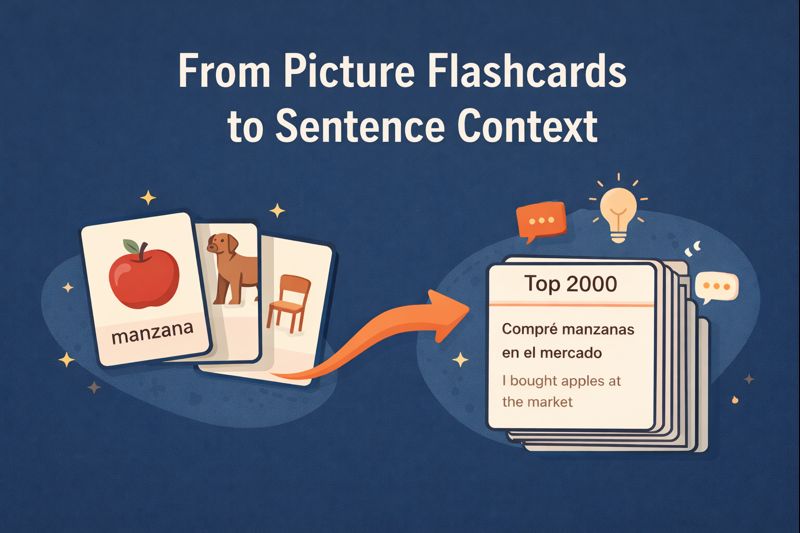
If you’ve recently completed a picture-based vocabulary deck, you might be wondering: “What’s my next step?” This question came from Albert, one of our Spanish learners in the Speakada community, and it’s one that language learners across all levels frequently ask.
Albert had just finished working through our Spanish 500 Picture Words deck and was considering the Spanish Top 2000 Words deck. His concern was simple but valid: “Wouldn’t there be significant overlap? What would I actually gain from moving to the frequency-based deck?”
This is a smart question that reveals a deep understanding of efficient learning. After all, nobody wants to waste time reviewing the same material twice. But the answer might surprise you—and it applies whether you’re learning Spanish, French, Italian, German, English, Dutch, or Polish with Anki language learning flashcards.
Understanding the Role of Different Vocabulary Flashcard Types
Before diving into the overlap question, let’s establish why different types of vocabulary flashcards exist in the first place. Not all vocabulary decks serve the same purpose in your language learning journey, even when they cover similar content.
Picture-based flashcards and frequency-based sentence flashcards represent two distinct stages in vocabulary acquisition. Think of them as different tools in your language learning toolbox—each designed for specific jobs at specific times in your progression.
The Foundation: Picture-Based Vocabulary Learning
Picture flashcards serve as your entry point into a new language. When you’re just starting out, your brain needs concrete anchors to attach new words to. A picture of an apple paired with the word “manzana” (in Spanish), “pomme” (in French), or “Apfel” (in German) creates an immediate, universal connection that bypasses translation.
This visual method works exceptionally well for concrete nouns—objects you can see, touch, or point to. It’s fast, memorable, and builds confidence quickly. That’s why picture-based decks typically cover 500-600 words: they focus on the most tangible, visually representable vocabulary that forms the foundation of any language.
The Evolution: Sentence Context and Real-World Usage
Frequency-based vocabulary decks, like the Top 2000 Words flashcards, take a completely different approach. Instead of pictures, they use sentences from real-world contexts. This shift isn’t arbitrary—it reflects how you’ll actually encounter and use these words in authentic communication.
When you progress to sentence-based learning, you’re not just memorizing isolated words anymore. You’re learning grammar patterns, word combinations, and natural usage all at once. The word “apple” isn’t just a fruit anymore—it’s “I bought apples at the market,” “These apples taste sweet,” or “Do you prefer apples or oranges?”
The Overlap Question: Less Than You’d Think
Now, let’s address Albert’s specific concern: the overlap between picture-based and frequency-based decks.
Yes, there is some overlap. You’ll definitely encounter familiar words when you move from a 500 Picture Words deck to a Top 2000 Words deck. However, the overlap is far less extensive than most learners anticipate, and here’s why.
Different Source Material, Different Outcomes
The Top 2000 Words flashcards use raw frequency lists—mathematical rankings of how often words actually appear in real speech and writing. These lists come from analyzing millions of words across books, newspapers, conversations, and modern media.
Picture vocabulary decks also consider frequency, but with a critical constraint: every word must be visually representable. This requirement automatically excludes hundreds of high-frequency words that can’t be shown in a picture.
The Abstract Vocabulary Gap
Here’s where the real difference emerges. Think about these commonly used words:
- Although
- However
- Ability
- Movement
- Perhaps
- Therefore
- Considering
- Relationship
These words appear constantly in everyday speech and writing. They’re essential for expressing complex thoughts, making arguments, and understanding native speakers. But you can’t draw a picture of “however.”
This abstract vocabulary represents a massive gap that picture-based decks simply cannot fill. When you progress to a frequency-based deck, you’re not primarily learning more concrete nouns—you’re gaining access to the connective tissue of the language: adverbs, conjunctions, abstract nouns, and conceptual verbs that allow for sophisticated communication.
Learning Logic vs. Real-World Frequency
Picture-based decks also include certain words for pedagogical reasons rather than pure frequency. For example, numbers are typically included in logical sequence: one, two, three, four, five, etc. This helps you understand the counting system.
But in reality, some numbers appear far more frequently than others. “One,” “two,” and “ten” are very common, but “seventy-three” might not crack the top 2000 most-used words at all. Frequency-based decks reflect actual usage patterns, not pedagogical logic.
Beyond Overlap: Different Learning Objectives
Even when the same word appears in both deck types, you’re learning different things. This is perhaps the most misunderstood aspect of vocabulary progression.
From Recognition to Active Use
The 500 Picture Words deck teaches recognition and basic association. You see a picture, you recall a word. This builds your passive vocabulary quickly and effectively.
The Top 2000 Words deck teaches active usage in context. You’re not just recognizing “dog” anymore—you’re learning “The dog barked loudly,” “She walks her dog every morning,” or “Is that your dog?” You’re absorbing grammar patterns, common collocations, and natural sentence structures.
This progression from recognition to usage is crucial. Many language learners can recognize thousands of words but struggle to use even a few hundred in conversation. Context-based learning bridges this gap.
Grammar Acquisition Through Natural Exposure
When you study grammar flashcards explicitly, you’re learning rules. But when you study vocabulary in sentence contexts, you’re absorbing grammar patterns naturally through repeated exposure.
Every sentence in a frequency-based deck demonstrates grammar in action: verb conjugations, article usage, word order, preposition selection, and more. Your brain begins to recognize these patterns automatically, even before you can articulate the rules.
This implicit grammar learning is powerful because it builds intuition—the ability to “feel” what sounds right in your target language.
The Strategic Progression Path
So how should you structure your vocabulary learning for maximum efficiency? Here’s the strategic path that takes you from complete beginner to solid intermediate.
Stage 1: Foundation Building With Picture Flashcards (A1 Level)
Start with picture-based vocabulary flashcards like our 500 Picture Words decks. These build your foundation quickly with minimal cognitive load. You’ll learn the most common concrete nouns, basic verbs, essential adjectives, and fundamental concepts.
At this stage, you’re building recognition speed and confidence. You’re training your brain to think in your target language rather than constantly translating. This foundation is crucial for everything that follows.
Stage 2: Context and Usage Expansion (A2-B1 Level)
After completing your picture vocabulary foundation, progress to frequency-based decks like our Top 2000 Words flashcards. Here you’ll encounter all those abstract words that were impossible to picture, plus you’ll see your existing vocabulary used in natural contexts with proper grammar.
This stage transforms you from someone who knows isolated words into someone who understands actual language as it’s used by native speakers. You’re building comprehension and usage skills simultaneously.
Stage 3: Specialized and Advanced Vocabulary (B2+ Level)
Once you’ve covered the top 2000 frequency words, you have approximately 90% comprehension of most general texts. At this point, you can branch into specialized areas: intermediate grammar flashcards, topic-specific vocabulary, or common phrases for natural conversation flow.

Real-World Application: What the Numbers Tell Us
Understanding the coverage percentages helps clarify why both deck types matter. Research consistently shows that the most frequent 1000 words in any language provide about 75-80% coverage of everyday texts. The next 1000 words (words 1001-2000) add approximately 10-15% more coverage.
Picture-based decks covering 500 words typically capture about 60-65% of common texts, focusing heavily on concrete, high-frequency nouns. But they miss the crucial connective words and abstract vocabulary that make up much of the remaining percentage.
When you combine picture-based learning (500 words) with frequency-based learning (2000 words), accounting for overlap, you typically acquire around 2200-2400 unique vocabulary items. This combined approach provides significantly better coverage than either method alone.
Pronunciation Matters Throughout Your Journey
While we’re discussing vocabulary progression, it’s worth noting that pronunciation practice should accompany you through every stage. Many learners focus exclusively on vocabulary acquisition and grammar, only to discover later that their pronunciation habits have solidified incorrectly.
Whether you’re working through picture flashcards or frequency-based decks, make sure you’re hearing and repeating words correctly from the start. Our pronunciation bundles include IPA (International Phonetic Alphabet) flashcards and minimal pairs practice to ensure you’re building proper pronunciation habits alongside your vocabulary growth.
Addressing Common Concerns About Deck Progression
“Won’t I Get Bored Reviewing Words I Already Know?”
This concern assumes that recognition equals mastery, but language learning doesn’t work that way. Seeing “casa” in a picture deck and seeing “Mi casa es tu casa” or “Volví a casa tarde anoche” in a sentence deck are fundamentally different learning experiences.
Additionally, Anki’s spaced repetition algorithm quickly identifies words you know well and schedules them less frequently. If you truly have mastered a word in all contexts, you’ll see it rarely. If seeing it in new contexts reveals gaps in your understanding, you’ll see it more often—exactly when you need the practice.
“Should I Finish the Picture Deck Completely Before Starting the Frequency Deck?”
Not necessarily. Once you’ve learned 60-70% of a picture-based deck, you can begin introducing sentence-based cards alongside your picture review. This parallel approach helps reinforce your existing vocabulary while expanding into new territory.
Many successful language learners maintain multiple decks simultaneously, using Anki’s review system to balance their practice across different skill areas.
“What If I’m Learning Multiple Languages?”
The same progression principles apply to all languages. Whether you’re studying Anki Spanish flashcards, Anki French flashcards, Anki German flashcards, or any of the other languages available at Speakada, the path from picture-based to context-based learning remains consistent.
The beauty of this systematic approach is that once you understand the progression in one language, you can apply the same strategy to any additional languages you study.
Getting the Most From Your Flashcard Practice
To maximize your investment in both picture and frequency-based flashcards, keep these practices in mind:
Be consistent with daily reviews. Anki works best with regular, daily practice rather than irregular cramming sessions. Even 15-20 minutes daily produces better results than hour-long sessions twice a week.
Say words out loud. Don’t just think the answer—speak it. This activates different neural pathways and builds the muscle memory crucial for actual conversation.
Use new vocabulary immediately. Try to use newly learned words in conversation, writing, or even thinking to yourself. This active usage cements learning far more effectively than passive review.
Trust the spaced repetition algorithm. Anki’s scheduling might seem counterintuitive at times, but it’s based on decades of memory research. Trust the system and focus on honest self-assessment of your recall.
The Path Forward: Your Next Steps
If you’ve completed a picture-based vocabulary deck in any language, the natural next step is to progress to frequency-based, sentence-context learning. The overlap will be minimal, and the learning benefits will be substantial.
For Spanish learners like Albert, that means moving from the Spanish 500 Picture Words deck to the Spanish Top 2000 Words deck. For French learners, it’s from French Picture Words to French Top 2000. The same logical progression applies across all our supported languages.
This strategic approach takes you from beginner recognition to intermediate comprehension, from isolated words to contextual understanding, and from passive knowledge to active usage.
Continue Your Language Learning Journey
The question Albert asked reflects the thoughtfulness of serious language learners in our community. If you’re asking similar questions about your learning path—whether it’s about vocabulary progression, grammar integration, or pronunciation improvement—you’re exactly the kind of engaged learner who benefits most from systematic approaches.
Want more insights like this delivered to your inbox? Subscribe to the SPEAKADA WEEKLY newsletter for free tips, strategies, and ideas for smart language learning with Anki flashcards. Join thousands of language learners who are optimizing their study routines and achieving their fluency goals faster.
Whether you’re just starting with your first picture flashcards or you’re ready to dive into advanced grammar concepts, understanding the strategic progression of your learning materials makes all the difference. Each deck type serves a specific purpose, and when used in the right sequence, they build upon each other to create comprehensive language proficiency.
The overlap you might worry about? It’s not a bug—it’s a feature. Seeing familiar vocabulary in new contexts solidifies your knowledge and expands your usage abilities. That’s not wasted time; that’s accelerated learning.
Your next level of fluency is waiting. The only question is: are you ready to take that next step?
Have questions about which flashcard deck is right for your current level? The Speakada community is here to help. Explore our complete collection of Anki language learning flashcards or request custom flashcards tailored to your specific learning needs.
1000 Most Common Spanish Words List and How to Use It The 1000 most common Spanish words are the top Read more
How to Learn Spanish Vocabulary If you're new to learning Spanish, or if you want to improve your Spanish, then Read more
How to Learn Vocabulary in a Smart and Effective Way Embarking on a journey to master a new language is Read more
As the new year is quickly approaching, you might be thinking about setting a goal to really learn Spanish. Although Read more