
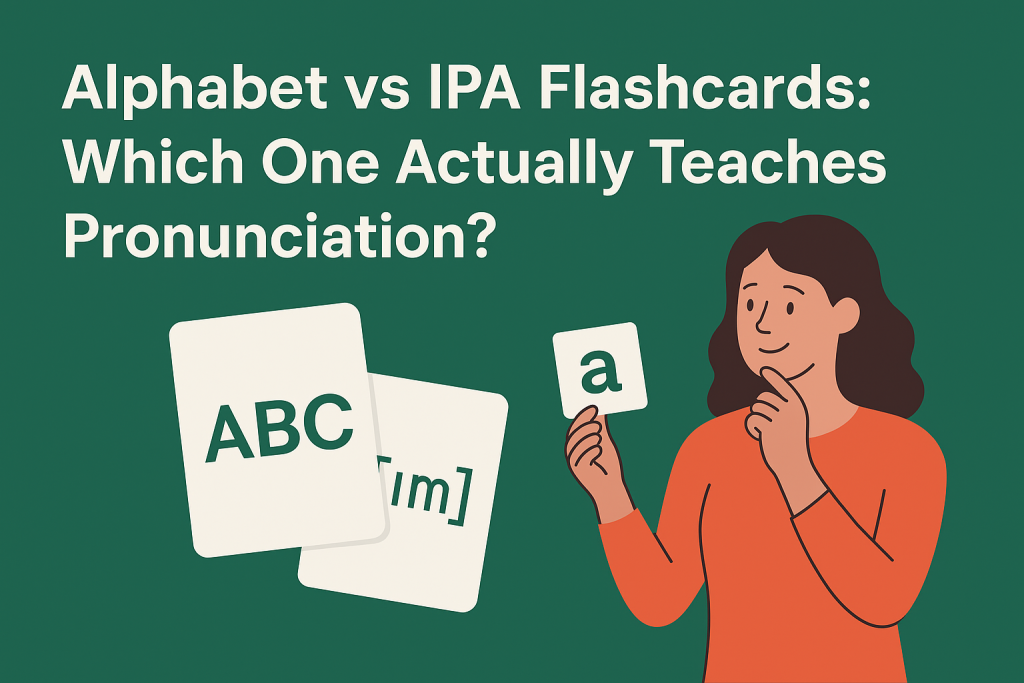
If you’ve ever wondered why your language learning flashcards seem to be missing certain letters or sounds, you’re not alone. Many learners contact us confused about accented letters, special characters, and pronunciation symbols in their Anki decks. The truth is, those sounds aren’t missing—they’re just organized differently than you might expect.
Understanding the difference between alphabet flashcards and IPA (International Phonetic Alphabet) flashcards will transform how you approach pronunciation in any language. Let’s break down why both tools matter and how to use them effectively with your Anki Language Learning Flashcards.
The Common Confusion About Pronunciation Flashcards
Recently, Caleb, a Portuguese learner, reached out thinking his flashcards were incomplete because he couldn’t find letters like “é” and other accented sounds. This is a common misunderstanding that highlights an important distinction in language learning tools.
The issue wasn’t that anything was missing. Caleb simply didn’t realize he had two complementary pronunciation systems working together in his bundle: the standard alphabet deck and the IPA deck. Each serves a specific and crucial purpose in developing authentic pronunciation skills.
What Are Alphabet Flashcards?
Your alphabet flashcards cover the standard letters—typically the 26 building blocks you’d recognize on a keyboard, plus any additional standard letters in your target language. These flashcards form your foundation for reading and spelling.
When you study Pronunciation Flashcards, the alphabet portion teaches you:
- How each basic letter sounds in your target language
- Standard letter names and their typical pronunciation
- The fundamental building blocks for spelling
- How letters differ from English pronunciation
For example, if you’re learning Anki Spanish Flashcards, your alphabet deck covers A-Z and the additional letter “ñ.” If you’re studying Anki French Flashcards, you’ll learn the standard French alphabet and how vowels sound different from English.
What Are IPA Flashcards?
This is where pronunciation truly comes alive. IPA (International Phonetic Alphabet) flashcards are your comprehensive guide to every sound in your target language—including all those special sounds that don’t exist in English.
Your IPA flashcards cover:
- Accented letters and their specific sounds (é, ó, â, ü, etc.)
- Unique phonetic combinations
- Sound variations that aren’t represented by single letters
- The precise mouth and tongue positions for authentic pronunciation
For Portuguese, while the alphabet deck covers A-Z, the IPA deck includes “é,” “ó,” “â,” and all the pronunciation variations that give Portuguese its distinctive sound. Similarly, German IPA Flashcards cover umlauts (ä, ö, ü) and unique consonant combinations, while Polish IPA Flashcards help you master those challenging nasal vowels and consonant clusters.
Why Spelling and Pronunciation Don’t Match
Here’s a fundamental truth about language learning: in most languages, spelling doesn’t reliably indicate pronunciation. This gap between written letters and spoken sounds is exactly why you need both alphabet and IPA flashcards.
Consider these examples:
Spanish: The word “calle” (street) is spelled with double L, but depending on the region, it’s pronounced [ˈkaʎe] or [ˈkaje]—sounds you won’t understand from the alphabet alone.
French: The word “beaucoup” (much/many) has eight letters but only four sounds: [boku]. The written form tells you almost nothing about how to actually say it.
Italian: The letter “c” can sound like [k] in “casa” or [tʃ] in “ciao”—a distinction only IPA can clarify precisely.
This is why learners who use Vocabulary Flashcards without pronunciation guidance often develop inaccurate speaking habits that become difficult to correct later.
The Science Behind IPA for Language Learning
You might wonder why we should bother with those strange phonetic symbols. After all, can’t you just listen and repeat?
Research published in Theory and Practice in Language Studies demonstrated that students who learned IPA symbols developed significantly better phonological awareness compared to those who didn’t. This enhanced awareness translated directly into improved speaking and writing skills.
The reason is simple: IPA gives you a mental framework for understanding sounds. Instead of vaguely trying to mimic what you hear, you develop conscious knowledge of:
- Exactly which sounds exist in your target language
- How those sounds differ from English
- Where your tongue and lips should be positioned
- Which sounds you’re most likely to confuse
When you combine this knowledge with spaced repetition in Anki, you’re using one of the most efficient pronunciation learning methods available. How Anki Works to Learn a Language Better explains the cognitive science behind why this approach is so effective.
A Real-World IPA Example
Let’s look at a concrete example to make this practical. Take the Spanish “ñ” sound—one of the most recognizable features of Spanish pronunciation.
In the alphabet deck: You see the letter “ñ” and learn it’s a distinct letter in Spanish.
In the IPA deck: You see [ɲ] and learn that it sounds like “ny” in the English word “canyon.” You get specific guidance: your tongue touches the roof of your mouth in a particular way, similar to the “n” sound but with the tongue spread wider.
This specific, technical guidance transforms your pronunciation from “close enough” to confident and accurate. You’re not guessing—you’re applying systematic knowledge.
The same principle applies across languages:
- Italian Pronunciation Bundle includes IPA for the rolled “r” sound [r]
- Dutch IPA Flashcards teach the guttural “g” sound [ɣ]
- French IPA Flashcards clarify nasal vowels like [ɑ̃], [ɛ̃], and [ɔ̃]
How to Use Both Decks Effectively
If you already have a pronunciation bundle, here’s how to maximize both tools:
Start with the alphabet deck. Build your foundation by learning how basic letters sound. This gives you the framework for reading words.
Progress to the IPA deck. Once you’re comfortable with basic letters, dive into the IPA symbols. These teach you the authentic sounds that create native-like pronunciation.
Use them together. When you encounter a new word, first identify the letters (alphabet knowledge), then determine the precise sounds (IPA knowledge).
Practice with minimal pairs. Our Spanish Minimal Pairs Flashcards and similar decks for other languages help you distinguish between similar sounds—a critical skill that IPA knowledge makes much easier.
Let Anki’s algorithm guide you. The spaced repetition system focuses on the sounds you find most challenging. You’re not wasting time on sounds you’ve already mastered.
This systematic approach is why users consistently report that Speakada Anki flashcards help them develop more authentic pronunciation than other methods.

Common Questions About IPA Flashcards
“Isn’t IPA too complicated for beginners?”
Actually, IPA is incredibly beginner-friendly because it removes ambiguity. Instead of guessing how a letter sounds, you know exactly. Many learners find IPA easier than trying to decipher vague descriptions like “pronounce it like the ‘a’ in father but shorter.”
“Do I really need to learn symbols? Can’t I just listen?”
Listening is essential, but without IPA, you might not hear the distinctions. Your brain tends to map foreign sounds to familiar ones. IPA trains you to consciously recognize subtle differences—especially important for sounds that don’t exist in English.
“Which languages benefit most from IPA?”
All of them. Even if you’re learning Anki English Flashcards as a non-native speaker, IPA helps you master English’s notoriously irregular pronunciation. Languages with more consistent spelling systems, like Spanish or Italian, still benefit because IPA captures subtle variations that spelling doesn’t show.
The Independence IPA Gives You
Here’s one of the most powerful benefits of learning IPA: independence. Once you understand phonetic symbols, you can pick up any dictionary, look at any word, and know exactly how to pronounce it—without needing to hear it first.
This skill becomes invaluable as you advance in your language learning journey. When you encounter a new word in a book or article, you don’t need to search for an audio recording. You can see the IPA transcription in your dictionary and pronounce it correctly immediately.
This independence accelerates your learning across all skills:
- Reading: You can tackle more advanced texts confidently
- Speaking: You build correct pronunciation habits from the start
- Listening: You recognize words more easily when you know their exact sounds
- Writing: You understand sound-spelling relationships better
For learners using Grammar Flashcards alongside pronunciation practice, this independence means you can focus on constructing sentences without worrying about looking up every new word’s pronunciation.
Getting Started with Pronunciation Bundles
If you’re not currently using both alphabet and IPA flashcards, now is the perfect time to upgrade your pronunciation practice. Our pronunciation bundles include both tools working together:
- Spanish Pronunciation Bundle
- French Pronunciation Bundle
- German Pronunciation Bundle
- Italian Pronunciation Bundle
- Dutch Pronunciation Bundle
- Polish Pronunciation Bundle
- English Pronunciation Bundle
Each bundle includes alphabet flashcards for basic letter sounds, IPA flashcards for comprehensive pronunciation coverage, and minimal pairs to train your ear to distinguish similar sounds.
The combination gives you complete pronunciation coverage—from basic letter recognition to authentic native-speaker pronunciation. And with Anki’s spaced repetition, you’ll master both systems without feeling overwhelmed.
Beyond Pronunciation: Building Complete Language Skills
While pronunciation is fundamental, it’s just one component of language mastery. Once you’ve built a solid foundation with pronunciation flashcards, you can expand your learning with:
Vocabulary building: Our vocabulary bundles help you systematically acquire the most useful words in your target language, from essential picture words to the top 2000 most common words.
Grammar mastery: Understanding how to construct sentences correctly is crucial. Whether you’re at the beginner level (A0-A2), intermediate level (B1-B2), or advanced level (C1), targeted grammar flashcards reinforce the structures you need.
Common phrases: Real conversations require more than individual words. Learning common phrases helps you sound more natural and fluent in everyday situations.
The most successful language learners combine all these elements, building a comprehensive skill set that enables genuine communication.
Your Next Steps for Better Pronunciation
Whether you’re just starting your language learning journey or you’re an advanced learner looking to refine your accent, understanding the alphabet versus IPA distinction will clarify your path forward.
For existing customers: Check your decks to ensure you’re using both alphabet and IPA flashcards. Your IPA deck might be waiting there, ready to unlock those authentic sounds that transform your pronunciation from “understandable” to “impressive.”
For new learners: Consider starting with a complete pronunciation bundle rather than piecing together resources. The integrated approach saves time and ensures you’re building correct habits from day one.
For all learners: Remember that both decks work together synergistically. The alphabet gives you the letters; the IPA gives you the sounds. Combined with Anki’s spaced repetition algorithm, you’ll develop native-like pronunciation efficiently and systematically.
Want to stay updated with more smart language learning strategies? Subscribe to the SPEAKADA WEEKLY newsletter for free tips, pronunciation guides, and proven techniques that help you learn faster and speak with confidence. Join thousands of learners who are making their language goals a reality with evidence-based methods and expert guidance delivered directly to your inbox.
Final Thoughts
Pronunciation isn’t about perfection—it’s about clarity, confidence, and connection. When you can pronounce words correctly, you communicate more effectively, you’re understood more easily, and you feel more confident engaging in conversations.
The alphabet versus IPA distinction might seem technical at first, but it’s actually quite simple: one teaches you letters, the other teaches you sounds. Together, they give you everything you need for authentic pronunciation.
Don’t let confusion about these two tools hold you back. Now that you understand how they work together, you can use both strategically to develop the clear, confident pronunciation that makes language learning rewarding.
Ready to transform your pronunciation? Explore our pronunciation flashcards or browse our complete selection of Anki language learning flashcards for your target language.
Happy learning!
Looking for more language learning insights? Check out our Anki Language Learning Blog for articles on vocabulary acquisition, grammar mastery, speaking fluency, and effective study strategies.
How to Speak With a French Accent When you begin to learn French, there are so many elements that you Read more
How to Speak With a Spanish Accent Now When you begin to learn Spanish, there are so many elements that Read more
How to Pronounce French Words Although the French language is similar to English in some respects, many French learners still Read more
How to Speak With a German Accent When you begin to learn German, there are so many elements that you Read more