
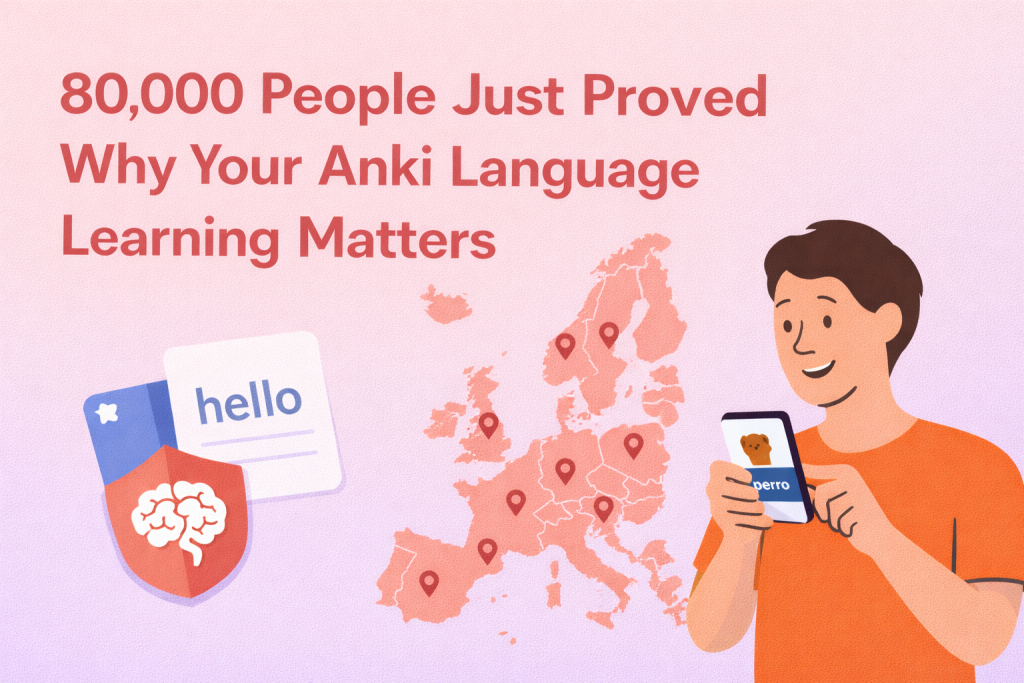
Have you ever wondered if your daily Anki flashcard practice is doing more than just helping you order coffee in Paris or navigate the streets of Barcelona? What if every time you reviewed those vocabulary flashcards or practiced pronunciation drills, you were actually building a protective shield around your brain?
Recent groundbreaking research has revealed something that will change how you think about language learning forever. According to a massive study published in Nature Aging, people who speak multiple languages are half as likely to show signs of accelerated brain aging compared to monolingual speakers. This isn’t just another small-scale study with questionable results—this research followed over 80,000 people across 27 European countries, making it the largest and most decisive evidence we’ve ever had about multilingualism’s impact on cognitive health.
The Research That Changes Everything
For years, scientists have debated whether speaking multiple languages could genuinely delay cognitive aging or if it was simply correlation rather than causation. Previous studies showed promising results but were limited by small sample sizes and inconsistent methodologies. This new research, however, addresses what neuroscientist Agustín Ibáñez calls “one of the most persistent gaps in aging research.”
The study’s scale and methodology make its findings particularly compelling. Researchers analyzed participants aged between 51 and 90 years, examining what they call the “biobehavioural age gap”—the difference between how old you are chronologically and how old your body and brain appear to be based on various physiological, lifestyle, and socioeconomic factors.
The results were striking. Even speaking just one additional language reduces your risk of faster cognitive aging. When participants spoke two or three extra languages, the protective effect became even stronger. As cognitive psychologist Susan Teubner-Rhodes notes, the study’s large, geographically diverse sample allowed researchers to control for numerous confounding factors like immigrant status and wealth, strengthening the interpretation that multilingualism itself provides this protection.
What This Means for Your Language Learning Journey
If you’re currently working through Anki Spanish flashcards or Anki French flashcards, this research should give you renewed motivation. Every practice session isn’t just about mastering irregular verbs or perfecting your pronunciation—it’s an investment in your brain’s long-term health.
Think about it this way: when you practice with pronunciation flashcards, you’re engaging multiple cognitive systems simultaneously. You’re processing audio information, activating motor control for speech production, accessing memory networks, and often visualizing spelling or context. This complex cognitive workout is exactly what keeps your brain sharp and resilient against aging.
The same applies when you’re working through grammar flashcards or building vocabulary. Each flashcard review activates neural pathways, strengthens connections, and builds cognitive reserve—the brain’s ability to improvise and find alternate ways of getting tasks done.
Why Anki Flashcards Are Particularly Powerful for Brain Health
Anki language learning leverages something called spaced repetition, which isn’t just effective for memorization—it’s also optimal for brain health. Here’s why:
Active Recall Strengthens Neural Connections: Every time you try to remember a word or grammar rule before flipping a flashcard, you’re forcing your brain to actively retrieve information. This process strengthens the neural pathways associated with that information, making it both more accessible and more resistant to age-related decline.
Spaced Repetition Optimizes Long-Term Retention: How Anki works is based on the spacing effect—reviewing information at gradually increasing intervals. This creates stronger, more durable memories that are less likely to fade as you age. It’s like the difference between cramming for an exam (information quickly forgotten) and truly learning something that becomes part of your permanent knowledge base.
Comprehensive Language Skills Build Cognitive Reserve: When you use a system like Speakada Anki flashcards that covers pronunciation, vocabulary, and grammar together, you’re giving your brain the most comprehensive workout possible. For instance, working through the Spanish Pronunciation Bundle engages your auditory processing, while the Spanish Grammar Bundle challenges your analytical and pattern-recognition abilities.
The Multilingual Brain: Understanding the Protective Mechanism
Why does multilingualism offer such powerful protection against brain aging? Researchers believe several mechanisms are at work:
Enhanced Cognitive Control: When you speak multiple languages, your brain constantly manages which language to use, suppressing one while activating another. This continuous exercise strengthens your brain’s executive function—the high-level cognitive processes that control behavior, decision-making, and problem-solving.
Increased Neural Plasticity: Learning and maintaining multiple languages requires your brain to remain flexible and adaptable. This neuroplasticity—your brain’s ability to reorganize itself and form new neural connections—is one of the most important factors in healthy aging.
Richer Neural Networks: Each language you learn creates extensive networks of connections in your brain. These redundant pathways provide what scientists call “cognitive reserve,” allowing your brain to function effectively even if some areas are affected by aging.
Continuous Cognitive Challenge: Maintaining proficiency in multiple languages requires ongoing practice and engagement, which keeps your brain active and challenged. This is particularly true when you use structured learning tools like Anki German flashcards or Anki Italian flashcards that progressively challenge you with new material.
It’s Never Too Late to Start
One of the most encouraging aspects of this research is that the protective effects of multilingualism can benefit people who start learning languages at any age. Whether you’re in your 20s working through beginner grammar flashcards or in your 60s tackling intermediate level content, you’re building cognitive reserve that will serve you well into older age.
The key is consistency. Daily practice with Anki language learning flashcards creates the sustained engagement that research shows is most beneficial. Even 15-20 minutes per day of focused practice can accumulate into significant cognitive benefits over time.
Practical Strategies for Maximizing Brain Health Through Language Learning
Based on this research and what we know about effective language learning, here are strategies to maximize both your language acquisition and cognitive health benefits:
Start with Fundamentals: Building a strong foundation is crucial. Whether you’re learning French, Dutch, or Polish, begin with essential pronunciation and core vocabulary before advancing to complex grammar structures.
Engage Multiple Skill Areas: Don’t just focus on vocabulary. Work on pronunciation, grammar, and practical phrases simultaneously. For example, if you’re learning Italian, consider combining Italian 500 Picture Words Flashcards with Italian IPA Flashcards and Italian Grammar Flashcards.
Make It Daily: Consistency matters more than intensity. Regular daily practice creates the sustained cognitive engagement that protects against aging. The spaced repetition system in Anki naturally encourages this daily habit.
Progress Gradually: As you advance, challenge yourself with more complex material. Moving from beginner flashcards to advanced grammar concepts ensures your brain continues receiving the cognitive challenge it needs.
Use Multiple Senses: The most effective learning engages multiple cognitive systems. This is why pronunciation flashcards that include audio are particularly valuable—they activate both auditory processing and motor planning for speech production.

Beyond Individual Words: The Bigger Picture
While building vocabulary with resources like Spanish Top 2000 Words Flashcards or French Top 2000 Words Flashcards is important, remember that real cognitive benefits come from active language use. Combine your flashcard practice with conversation, reading, and listening to maximize both your language skills and brain health benefits.
Consider supplementing your Anki practice with speaking fluency practice and exposure to books and audiobooks in foreign languages. The more you actively engage with the language, the stronger the cognitive benefits.
The Motivation Factor: Your Future Self Will Thank You
Learning a language can be challenging. There will be days when reviewing flashcards feels tedious, when grammar rules seem impossibly complex, or when pronunciation feels beyond your reach. On those days, remember this: you’re not just learning to communicate in another language. You’re literally helping your brain age more slowly.
Every time you practice with your English pronunciation flashcards, German minimal pairs, or Dutch common phrases, you’re making a deposit in your cognitive health bank account. The returns on that investment compound over decades, potentially reducing your risk of cognitive decline by half.
Taking the Next Step
Whether you’re just starting your language learning journey or you’ve been at it for years, this research confirms what many language learners have intuitively felt: learning languages changes your brain in profound and lasting ways.
If you haven’t yet explored how Anki works to learn a language better, now is the perfect time to start. The combination of spaced repetition, active recall, and comprehensive language coverage makes it one of the most effective tools for building both language skills and cognitive reserve.
Ready to invest in your brain health while opening doors to new cultures and connections? Explore Anki language learning flashcards and start building the multilingual advantage that will serve you for life.
Want more evidence-based tips for effective language learning? Subscribe to the SPEAKADA WEEKLY newsletter where we share the latest research, practical strategies, and smart techniques for mastering languages with Anki flashcards. Join thousands of language learners who are already using science-backed methods to achieve their goals while building lifelong cognitive health. Sign up for the newsletter and never miss insights that could transform your learning journey.
The Bottom Line
The evidence is clear and compelling: speaking multiple languages isn’t just a useful skill or a cultural asset—it’s a powerful tool for protecting your brain against aging. With the largest study of its kind confirming that multilingualism can reduce the risk of accelerated aging by half, there’s never been a better reason to commit to language learning.
Your practice today, whether it’s working through Polish pronunciation flashcards or reviewing Spanish common phrases, is an investment in your cognitive health for decades to come. So keep going, stay consistent, and remember that every flashcard review is building not just language skills but a stronger, more resilient brain.
The question isn’t whether language learning is worth your time—the research has definitively answered that. The question is: which language will you learn first?
Make Flashcards Online to Learn Spanish Now One of the biggest challenges when learning Spanish is figuring out how to Read more
Most language learners aim for 10 Anki cards per day — but is that right for you? Discover the 3 Read more
Cloze Deletion Anki Guide - My Experience and What I Use Now In this article, I'm going to be talking Read more
Grammatical Gender and How to Learn Gender Nouns With Anki Recently we were asked a question about the use of Read more