
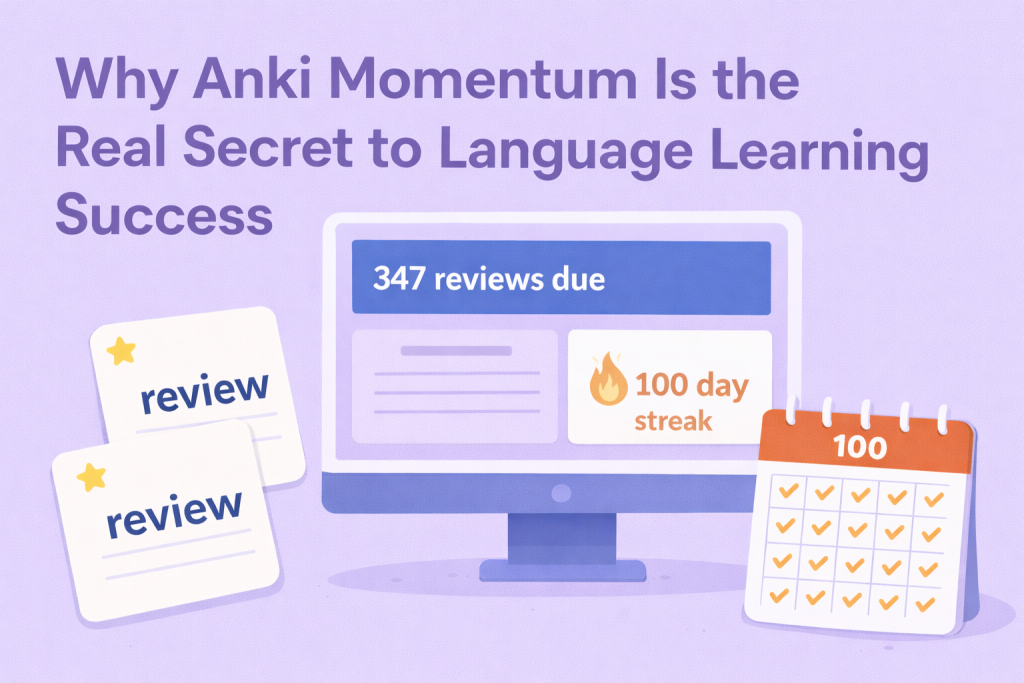
What separates Anki language learners who reach fluency from those who give up after a few weeks? It’s not natural talent, unlimited free time, or even exceptional motivation. The answer is simpler and more powerful than you might think: daily Anki momentum.
If you’ve ever downloaded Anki with excitement, created or imported decks, studied intensely for a week, then abandoned your reviews entirely, you already know the pattern. The blue “reviews due” number climbs higher each day. Guilt sets in. Eventually, you stop opening the app altogether.
The good news? Understanding how Anki momentum works can completely transform your language learning results. And the best part is that building this momentum doesn’t require hours of study each day—just 10-15 minutes of consistent Anki reviews.
The Hidden Challenge Most Anki Users Face
Here’s a truth that might surprise you: the hardest part of using Anki for language learning isn’t understanding how the algorithm works or finding quality decks. It’s showing up every single day to do your reviews, even when life gets in the way.
Think about your own Anki experience. Have you ever let your reviews pile up to 200, 500, or even 1,000+ cards? Have you felt overwhelmed by the red numbers and decided it was easier to just start over with a new deck?
This isn’t a failure of the Anki system or your discipline. It’s a failure of momentum.
When you do Anki reviews sporadically—crushing 300 cards one day, skipping a week, then cramming again—you’re fighting against the very algorithm designed to help you. Anki’s spaced repetition works by showing you cards at optimal intervals. When you skip days, those intervals get disrupted, cards pile up, and the system loses its effectiveness.
That’s where the concept of daily Anki momentum becomes crucial. And it’s exactly why Anki language learning flashcards work so effectively for thousands of successful language learners who maintain their daily review habit.
What Makes Anki the Perfect Momentum Builder for Language Learning
Anki is specifically designed to build the kind of daily momentum that leads to fluency. Instead of cramming everything at once (which your brain quickly forgets), Anki presents cards at strategically timed intervals—right when you’re about to forget them.
This spaced repetition approach does two powerful things:
First, it strengthens your memory more efficiently than traditional study methods. When you recall information just as it’s fading from memory, you reinforce that neural pathway much more effectively than if you reviewed it too early or too late. This is the science behind why Anki works to learn a language better.
Second, and perhaps more importantly for momentum, Anki requires just 10-15 minutes of daily practice. When you keep up with your reviews, Anki doesn’t overwhelm you. The algorithm spreads out your learning load. This isn’t a grueling study session that you’ll dread and eventually skip. It’s a sustainable habit that fits into even the busiest schedule—before breakfast, during your lunch break, or while commuting.
The key is consistency over intensity. Would you rather cram 300 Anki cards once a week, or review 30-50 cards every single day? Science and experience both point to the same answer: daily Anki practice wins every time.
This is why quality Anki pronunciation flashcards, Anki vocabulary flashcards, and Anki grammar flashcards create such powerful results. They’re not just teaching you the language—they’re building an unbreakable daily Anki habit.
The Three Pillars of Momentum-Based Anki Language Learning
Building lasting Anki momentum in language learning requires three essential elements working together in your deck collection:
1. Anki Pronunciation Foundations
Many Anki users skip proper pronunciation decks, thinking they’ll “pick it up naturally” through vocabulary cards alone. This is a critical mistake that can actually slow your Anki momentum.
When you learn pronunciation correctly from the start using dedicated Anki decks, everything else becomes easier. You can understand the audio on your vocabulary cards better. You feel more confident speaking. You avoid reinforcing bad habits through your Anki reviews that are difficult to break later.
Quality Anki pronunciation practice means more than just audio on the back of cards. It means systematic decks that teach you the phonetic patterns of your target language, help you recognize the subtle differences between similar sounds, and train your mouth to produce sounds that don’t exist in your native language.
Whether you’re using Anki Spanish flashcards, Anki French flashcards, Anki German flashcards, Anki Italian flashcards, Anki Dutch flashcards, Anki Polish flashcards, or Anki English flashcards, starting with pronunciation decks keeps your momentum strong because you’re building on correct patterns from day one.
2. Contextual Anki Vocabulary Decks
Random word lists in Anki kill momentum. Here’s why: when your Anki cards show “perro = dog” with no context, you haven’t really learned anything useful. You’ve memorized a translation, not how to use the word like a native speaker.
Effective Anki vocabulary decks show you words in context, with example sentences, common collocations, and natural usage patterns on your cards. Instead of learning isolated words, your Anki reviews teach you how natives actually communicate.
This contextual approach maintains Anki momentum because every new card you learn immediately becomes useful. You’re not just clicking through flashcards—you’re developing real communication skills with each review session.
The best Spanish Anki decks, best French Anki decks, and other quality deck collections prioritize this contextual approach to keep your daily reviews engaging and effective.
3. Anki Grammar Cards in Action
Traditional grammar instruction often presents rules in isolation: memorize the conjugation table, complete the workbook exercises, move on to the next chapter. When you try to translate this into Anki cards, you often end up with boring, abstract cards that drain your momentum.
Instead, effective Anki grammar decks show you patterns in action through your cards. You see how native speakers use the subjunctive mood in real conversations. You notice through repeated Anki reviews how verb tenses shift to express different meanings. You develop an intuitive feel for what sounds right through consistent exposure in your daily Anki sessions.
When your Anki grammar cards feel relevant and immediately applicable, they fuel your momentum instead of draining it. You’re eager to do your reviews because you can immediately use what you’ve learned.
The Power of an Anki Accountability Partner
Even with the perfect Anki decks and approach, maintaining momentum on your own can be challenging. This is where the power of an Anki learning partner comes in.
Studies show that people with an accountability partner are 65% more likely to reach their goals. For Anki language learners, this effect is especially pronounced because having an Anki accountability partner provides three crucial benefits:
Shared celebration of Anki wins. When you finally finish a difficult Anki deck—like completing all 2,000 cards in your German vocabulary deck or reaching a 100-day Anki streak—celebrating with someone who understands the Anki struggle makes the victory sweeter. These shared wins reinforce your momentum and make the daily review habit more enjoyable.
Mutual Anki accountability. It’s easy to skip your Anki reviews when you’re only accountable to yourself. But when someone else is counting on you—when you’ve committed to sharing your Anki stats or reviewing together—you’re far more likely to follow through even on difficult days.
Comparing Anki strategies. An Anki accountability partner gives you someone to discuss deck settings with, share tips about card creation, and troubleshoot problems together. You can compare which decks work best, discuss Anki add-ons, and learn from each other’s Anki journey.
Think about someone in your life who’s expressed interest in learning a language with Anki. Maybe it’s a friend who wants to learn Spanish. Perhaps it’s a family member interested in French. Or maybe it’s a colleague exploring German for professional opportunities.
Learning together with Anki multiplies the momentum for both of you. You’re not just building your own daily review habit—you’re building a shared Anki experience that makes consistency easier and progress faster.
Making Anki Momentum Automatic: Your Daily Review Routine
The ultimate goal is to make your Anki reviews so automatic that they require no willpower. Like brushing your teeth, Anki simply becomes something you do.
Here’s how to build that automatic Anki momentum:
Start with a specific Anki trigger. Don’t just plan to “do Anki reviews sometime today.” Instead, link your Anki time to an existing habit. Do Anki right after your morning coffee. Review flashcards during your commute. Open Anki before bed. The trigger makes the Anki habit automatic.
Keep the Anki barrier ridiculously low. Commit to reviewing just your due cards for the day, no matter how few. Not “at least 50 new cards” or “study for at least 30 minutes”—just do what Anki schedules for you. Making the commitment small eliminates the mental friction that leads to skipping days. You can always do extra reviews once you start, but the low barrier gets you to open the app.
Track your Anki streak. Something magical happens when you can see your consecutive days studied in Anki stats. Watching that number grow creates its own momentum. Breaking a 30-day Anki streak feels painful enough that you’ll push through difficult days to maintain it. Many Anki users report that their streak becomes a point of pride that keeps them consistent.
Focus on the Anki system, not outcome goals. Don’t fixate on “finishing this 5,000-card deck by December” or “learning 10,000 words this year.” These outcome-based goals can actually hurt Anki momentum because they emphasize what you haven’t achieved yet. Instead, focus on the system: “I do my Anki reviews every day.” This process-based approach keeps you engaged regardless of how quickly you progress through your decks.

How Systematic Anki Decks Support Your Daily Momentum
Creating your own Anki cards from scratch might seem like a good idea initially, but it can actually damage your momentum. When you’re constantly deciding what to add to Anki next, finding example sentences, recording audio, and organizing your decks, you’re wasting mental energy that could go toward actual learning.
This is where systematically designed Anki flashcard decks shine. Whether you’re using Spanish Anki decks, French Anki decks, Italian Anki decks, German Anki decks, Dutch Anki decks, Polish Anki decks, or English Anki decks, having a clear path forward maintains your momentum.
With well-designed Anki decks, you:
- Open Anki knowing exactly what to review each day
- Trust that the cards are ordered logically and effectively
- Avoid decision fatigue about what to study next
- Focus all your mental energy on learning, not deck maintenance
This systematic approach is what keeps Anki users engaged for months and years instead of weeks. The path through your Anki decks is clear, the progress is measurable through Anki’s built-in stats, and the momentum builds naturally.
For example, comprehensive collections like the Spanish Pronunciation Bundle, French Vocabulary Bundle, or Italian Grammar Flashcards Bundle provide a complete learning pathway. You don’t waste time wondering what to study next—you just do your daily Anki reviews and trust the system.
Understanding Why Anki Is Good for Language Learning Momentum
If you’re new to Anki or still skeptical about whether it’s worth the commitment, understanding the “why” behind Anki’s effectiveness can strengthen your momentum. There are 3 key reasons why Anki is useful for language learning:
The algorithm optimizes your review schedule so you remember more with less effort. The spaced repetition ensures you see cards right before you forget them. And the daily habit compounds over time—15 minutes today plus 15 minutes tomorrow doesn’t just equal 30 minutes of study; it equals stronger neural pathways and longer-lasting memories.
When you understand that every Anki session builds on the previous one, missing a day feels more costly. You’re not just skipping one review session—you’re disrupting the entire compounding effect of your Anki momentum.
Want More Strategies for Maintaining Your Anki Language Learning Momentum?
The strategies in this article are just the beginning. Building sustainable Anki momentum involves understanding optimal deck settings, choosing the right number of new cards per day, managing reviews when you travel, staying motivated through plateaus, and integrating Anki with other language learning activities.
Subscribe to the SPEAKADA WEEKLY newsletter to receive practical Anki tips, evidence-based strategies, and insider insights for smart language learning with Anki flashcards. Each week, you’ll discover new ways to maintain your Anki momentum and accelerate your progress toward fluency.
Your Next Steps: Building Anki Momentum Starting Today
Understanding Anki momentum is valuable. Building it is transformative.
If you’re ready to stop the cycle of downloading Anki, getting excited, then abandoning your reviews, here’s what to do:
First, commit to the daily Anki habit. Decide right now that you’ll do your Anki reviews every single day for the next 30 days. Not “most days” or “when possible”—every day. Write it down. Set a phone reminder. Make it real.
Second, understand the Anki system. If you’re new to Anki, learn how Anki works to learn a language better and discover why Anki is good for learning. Understanding the science behind the system strengthens your commitment to the daily habit.
Third, choose your Anki decks. Whether you’re starting with pronunciation decks, building vocabulary, or mastering grammar, pick systematic Anki flashcards and trust the process. Browse the Anki language learning blog for guidance on choosing the right decks for your level and goals.
Finally, find your Anki accountability partner. Identify someone who shares your language learning goals or who would benefit from learning with Anki alongside you. Reach out to them today. Propose using Anki together. Share your daily review stats. Build momentum as a team.
The Anki language learners who succeed aren’t the most talented or the most motivated. They’re the ones who build and maintain momentum through consistent daily Anki reviews. They open the app when it’s easy and when it’s hard. They trust Anki’s algorithm even when progress feels slow.
That can be you. Your Anki momentum starts today.
Real Success: What Consistent Anki Reviews Can Achieve
Still not convinced that daily Anki momentum matters? Consider what consistent Anki use looks like over time:
- After 30 days: You’ve reviewed the same core vocabulary 5-10 times at optimal intervals. These words are now solidly in your long-term memory.
- After 90 days: You’ve internalized pronunciation patterns through daily audio reviews. You can hear the difference between sounds that once seemed identical.
- After 180 days: You’ve accumulated hundreds or thousands of words, phrases, and grammar patterns that you can recall instantly. Your Anki deck has become a reliable foundation for real conversations.
- After a year: You’ve done over 365 Anki review sessions. The daily habit is now effortless. Your Anki stats show thousands of mature cards—knowledge that’s permanently accessible whenever you need it.
This is the power of Anki momentum. Not dramatic overnight transformation, but steady, reliable, compounding progress that adds up to real fluency.
Ready to build unbreakable Anki momentum? Explore our comprehensive collection of Anki language learning flashcards for Spanish, French, Italian, German, English, Dutch, and Polish. Each deck is systematically designed to build your skills through proven spaced repetition, so you can maintain daily momentum and achieve lasting fluency.

Make Flashcards Online to Learn Spanish Now One of the biggest challenges when learning Spanish is figuring out how to Read more

Most language learners aim for 10 Anki cards per day — but is that right for you? Discover the 3 Read more

Cloze Deletion Anki Guide - My Experience and What I Use Now In this article, I'm going to be talking Read more
Grammatical Gender and How to Learn Gender Nouns With Anki Recently we were asked a question about the use of Read more